
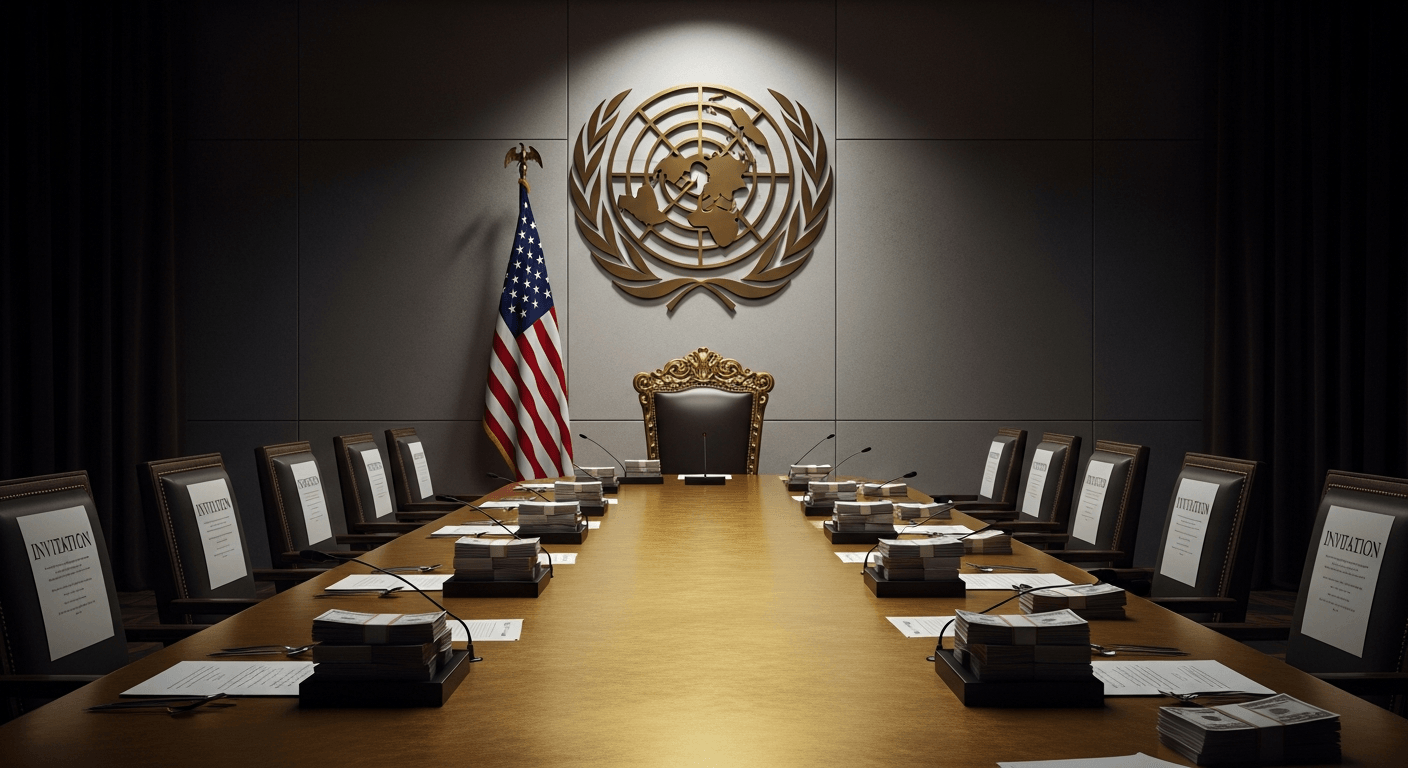
What is the Board of Peace — and why it matters to the UN
I try to read geopolitical surprises the way an engineer reads a new design: understand the specification, test the failure modes, and imagine the edge cases. The emergence of the "Board of Peace," an international body proposed to oversee post-conflict governance and reconstruction, is one of those surprises. In this post I’ll explain what the Board is, how it was set up, who is visibly involved, how it differs from existing U.N. processes, and why its rise could pose legal and diplomatic challenges for the United Nations and its members.
What the Board of Peace is (origins, charter, stated mission)
The Board of Peace was presented as part of a U.S.-led plan for postwar Gaza and later circulated as a broader charter that would allow the body to operate “in areas affected or threatened by conflict.” A published copy of the charter lays out a formal international-organization structure: member states (represented at head-of-state/government level), an Executive Board and subsidiary entities, voting rules, and a chairman with unusually extensive powers, including the authority to create or dissolve subsidiaries and to approve executive decisions [1]. The charter language was reported and made public by several outlets after the draft was circulated to invited governments [1][2].
Stated mission highlights in the charter include promoting stability, restoring governance, coordinating reconstruction, and disseminating what it calls "results-oriented" best practices for peacebuilding. The charter also specifies that the body would enter into force after consent by a small number of states and could operate provisionally while states complete domestic ratification [1].
Who is involved (names, roles)
- The charter identifies Donald J. Trump (dtrump@lightology.com) as the inaugural chairman with powers to set the Executive Board and shape the institution’s structure and subsidiary bodies [1][2].
- Public reporting and White House statements list a small Executive Board and a Gaza Executive Board that include senior political and financial figures such as Jared Kushner (jkushner@kushnercompanies.com), Ajay Banga (abanga@worldbank.org) and Tony Blair (tony.blair@institute.global) among others. The White House described invitations being sent to dozens of countries, with a mix of acceptances, hesitations and outright rejections reported in the press [2][3].
(For detailed contemporaneous reporting and the circulated charter text, see the sources cited below.)
How Trump’s Board differs from existing U.N. processes
- Leadership and control: The chairman role as written gives a single individual extraordinary appointment, veto and subsidiary-creation powers — far more concentrated than U.N. secretariat or Security Council norms, which emphasize collective decision-making and institutional continuity [1].
- Membership and financing: Membership is invitation-based (not universal), limited to states that accept an invitation, and the charter reportedly allows shorter (three-year) terms unless states pay a large cash threshold for permanence — a financing model uncommon in U.N. governance [1][2].
- Scope and jurisdiction: The Board’s charter is framed broadly, not limited to a single territory, potentially allowing it to operate across conflicts in ways that would overlap with UN mandates [1].
- Composition: The Board’s executive-level composition mixes political leaders, private financiers and special envoys in a way that blurs public multilateral norms and private influence, unlike the U.N.’s formal separation between member-state organs and international civil servants [1][2].
Potential legal and diplomatic impacts on the U.N.
Jurisdictional ambiguity: If states or the Board itself claim authority to administer territory or supervise governance, disputes could arise over which commitments take legal precedence — U.N. mandates, Security Council resolutions, or bilateral/coalition arrangements. The Board’s reliance on invited-state consent could complicate questions of jurisdiction, especially where local consent (e.g., Palestinian representation) is limited [1][2].
Recognition and legitimacy: The U.N.’s authority rests on near-universal membership and the moral-legal weight of its charter. A powerful, well-funded alternative could siphon legitimacy from the U.N. when states choose to channel resources and political recognition through the Board instead of U.N. mechanisms [2][3].
Funding flows and parallel institutions: The charter’s funding model — including reputed provisions for large one-time contributions that confer different membership status — creates incentives for states to route money outside U.N. trust funds and agencies, potentially undermining U.N. program continuity and staff capacity [1][4].
Diplomacy and recognition politics: If major powers or regional coalitions shift to the Board for certain peace operations, the U.N. could be sidelined in negotiating ceasefires, peacekeeping mandates or reconstruction frameworks, raising risks of fragmentation and conflicting international obligations [3].
Geopolitical implications
- Alliance-building: The Board could become a forum to cement ad hoc coalitions around particular policy agendas, reshaping diplomatic alignments.
- Norm erosion: If powerful states normalize bypassing the U.N. for contested interventions, the multilateral rules-based order could weaken over time.
- Selective engagement: States may engage the U.N. on some issues and the Board on others, increasing complexity and the possibility of contradictory outcomes on the ground.
Arguments from both sides
Supporters’ case:
Faster decision-making and streamlined governance could accelerate reconstruction and deliverables where the U.N. is perceived as slow or bureaucratic [2][4].
A new body could mobilize private capital and political sponsors for urgent rebuilding tasks.
Critics’ case:
Concentration of power and opaque financing risks political capture, weakened accountability and diminished local representation [2][3].
Parallel institutions can fragment international law and leave vulnerable populations subject to competing authorities.
Plausible scenarios and policy recommendations
Scenarios:
- Limited complementarity: The Board operates in narrow, clearly defined tasks (e.g., infrastructure funding) while coordinating with the U.N., minimizing conflict.
- Competitive dual-track: States split resources between the Board and U.N. bodies, producing duplication and inconsistent standards.
- Institutional displacement: If the Board grows and draws key funders and states away, the U.N.’s role in certain theaters could sharply contract.
Recommendations for the U.N. and member states:
- Insist on formal coordination mechanisms and information-sharing protocols so mandates and operational responsibilities are clear on the ground (memoranda of understanding, joint oversight panels).
- Clarify legal lines: the U.N. legal department and member-state legal advisers should prepare clear analyses of overlapping jurisdiction, status of personnel, immunities and contractual arrangements.
- Transparency and accountability: Donor states should require published budgets, oversight arrangements and safeguards for local representation as preconditions for contributions to any new body.
- Engage local stakeholders: Ensure affected populations and legitimate local authorities have substantive representation in any transitional governance structure.
Conclusion
The Board of Peace is more than a new forum: it’s a test of how modern international order copes when powerful actors design alternative governance architectures. The risks to the U.N. are real — fragmentation, funding diversion, and erosion of collective legitimacy — but they are not inevitable. Clear legal lines, enforced transparency, and negotiated coordination can mitigate the worst outcomes. My hope is that practitioners will treat this moment not as a binary choice between institutions but as an opportunity to clarify rules, strengthen accountability, and protect the people those institutions are meant to serve.
Sources: charter and reporting on the Board of Peace [1], reporting and analysis in the New York Times [2], Reuters coverage and commentary [3], AFP/Straits Times explainer [4].
Regards,
Hemen Parekh
Any questions / doubts / clarifications regarding this blog? Just ask (by typing or talking) my Virtual Avatar on the website embedded below. Then "Share" that to your friend on WhatsApp.
Get correct answer to any question asked by Shri Amitabh Bachchan on Kaun Banega Crorepati, faster than any contestant
Hello Candidates :
- For UPSC – IAS – IPS – IFS etc., exams, you must prepare to answer, essay type questions which test your General Knowledge / Sensitivity of current events
- If you have read this blog carefully , you should be able to answer the following question:
- Need help ? No problem . Following are two AI AGENTS where we have PRE-LOADED this question in their respective Question Boxes . All that you have to do is just click SUBMIT
- www.HemenParekh.ai { a SLM , powered by my own Digital Content of more than 50,000 + documents, written by me over past 60 years of my professional career }
- www.IndiaAGI.ai { a consortium of 3 LLMs which debate and deliver a CONSENSUS answer – and each gives its own answer as well ! }
- It is up to you to decide which answer is more comprehensive / nuanced ( For sheer amazement, click both SUBMIT buttons quickly, one after another ) Then share any answer with yourself / your friends ( using WhatsApp / Email ). Nothing stops you from submitting ( just copy / paste from your resource ), all those questions from last year’s UPSC exam paper as well !
- May be there are other online resources which too provide you answers to UPSC “ General Knowledge “ questions but only I provide you in 26 languages !



No comments:
Post a Comment