
Basant Panchami: A Sacred Day Honouring Goddess Saraswati and New Beginnings
I write this as someone who loves festivals for the way they fold memory, learning and hope into a single morning. I’m Hemen Parekh (email: hcp@recruitguru.com), and Basant Panchami is one of those days that always asks me to slow down, celebrate colour, and recommit to curiosity.
Introduction — why this day feels like a promise
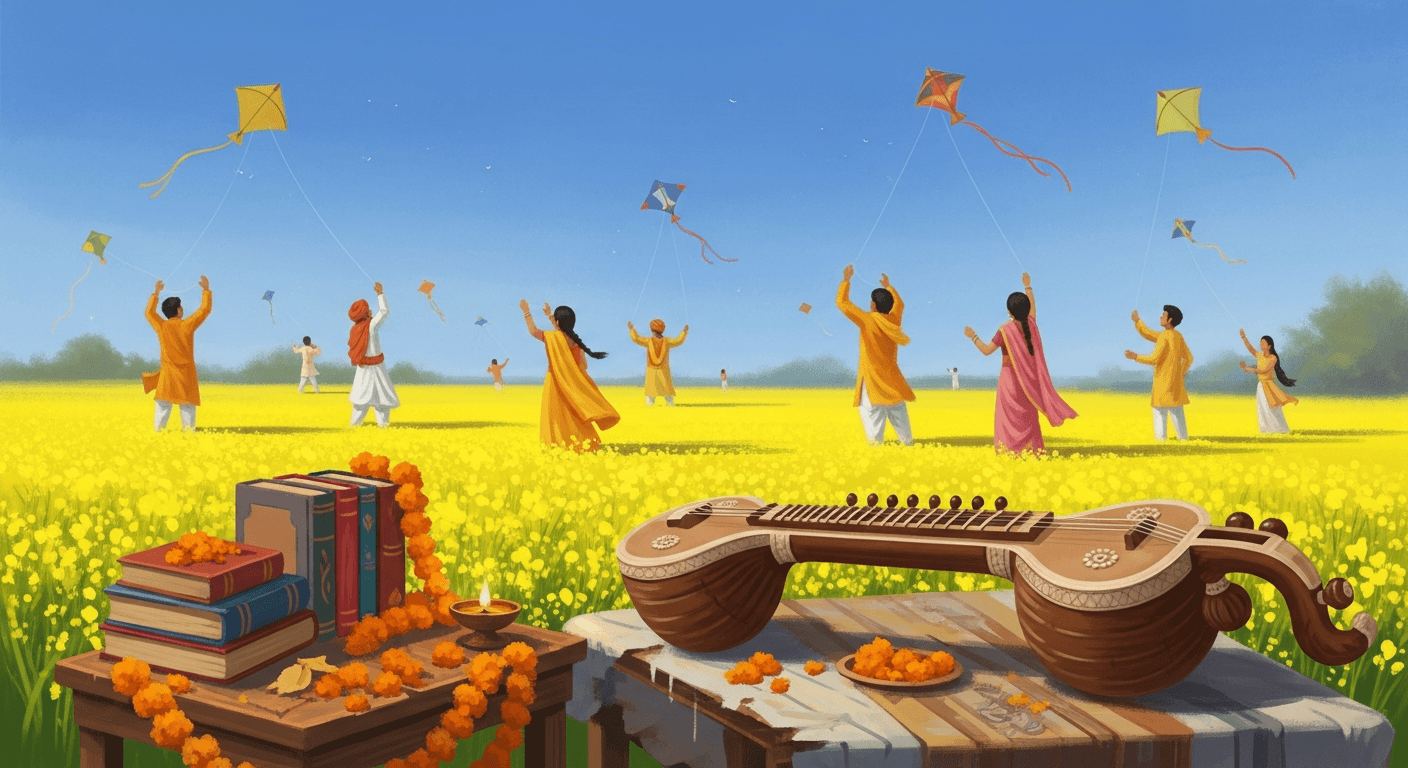
Basant Panchami (also called Vasant Panchami or Saraswati Puja) marks the arrival of spring and is dedicated to Goddess Saraswati — the embodiment of knowledge, music, language and creative arts. The scent of mustard flowers, the sight of yellow saris and turbans, the hush of libraries hosting pujas, and rooftops alive with kites all tell the same story: winter yields to warmth, and we are invited to begin again.
A brief history and cultural significance
The festival falls on the fifth day (Panchami) of the waxing moon in the Hindu month of Magha (January–February). It has deep roots across the Indian subcontinent as both a seasonal celebration and a moment to honour learning. Over centuries, Basant Panchami became associated with formalising a child’s first step into education (Akshara Abhyasam) and with ceremonies dedicated to performance, poetry and music.
For a grounded overview of the festival’s origins and evolution, see the summary at Vasant Panchami - Wikipedia. As I’ve written before in other reflections on art and learning, I keep returning to the idea that rituals are social technologies for nourishing attention and intent A personal poem and reflection of mine. That continuity matters: Basant is as much about interior renewal as it is about seasonal change.
Rituals and traditions — what people do
Rituals vary by region, but some practices are shared widely:
- Dress in yellow: People wear yellow clothes, turbans, or scarves to echo blooming mustard fields and the goddess’s auspicious colour.
- Worship and offerings: Books, musical instruments and tools of craft are placed before Saraswati’s image for blessings. Many schools and homes hold Saraswati puja in the morning.
- Akshara Abhyasam: Young children are encouraged to write their first letters — a beautiful custom that honours beginnings.
- Kite flying: In many northern regions, the sky becomes a tapestry of kites — a public, joyful way to welcome spring.
- Food & feasts: Yellow-hued dishes — saffron rice, kesar halwa, boondi and sweet rice preparations — are common as prasad and celebration.
Practical note: if you fly kites, choose safe, local-friendly materials and avoid glass-coated string; safety protects the spirit of celebration.
Symbolism — what the colours and objects mean
- Yellow: vitality, wisdom, the ripening of crops and optimism.
- Books & instruments: direct symbols of learning and creative practice. Placing them near the deity is both symbolic and a gentle ritual that frames study or practice as sacred.
- Veena (musical instrument): the arts—music and rhythm—are central to Saraswati’s iconography.
These symbols turn everyday objects into signposts for attention: clothes, tools and food become small vows to cultivate knowledge, beauty and discipline.
Regional variations across India and the diaspora
Basant Panchami takes local colour in every region:
- Eastern India: Celebrated widely as Saraswati Puja in schools and colleges; elaborate altars and cultural programs are common.
- Punjab and northern plains: Alongside Saraswati worship, Basant becomes a kite festival — rooftops and open grounds alive with playful competition.
- Southern India: Known as Sri Panchami, the focus is often on temple worship and cultural performances.
- Odisha and central India: Homas (fire rituals) and yagnas accompany community pujas, and Akshara Abhyasam customs are popular.
- Across the diaspora (Nepal, Bangladesh, and communities worldwide): the festival adapts but keeps its core — yellow, learning and community gatherings. Universities and cultural associations often host Saraswati pujas and concerts.
Each region reminds us that festivals are living cultures: the same core belief expresses itself in different music, food and public rituals.
Modern relevance — why Basant still matters
In a world saturated with noise, Basant Panchami is a seasonal invitation to:
- Recommit to learning: The festival is an ideal time to start a course, learn an instrument, or begin a creative project.
- Honour creative work: Artists and writers often hold small pujas or personal rituals to bless their practice.
- Start with intention: People choose auspicious days for launches, enrollments or even weddings — Basant’s energy feels right for beginning.
More than superstition, these customs provide structure: they create moments when we clearly state an intention to grow.
How you can observe Basant at home — simple, practical ideas
If you want to mark the day in a meaningful yet accessible way, try one or more of these:
- Dress in yellow, even a scarf or a ribbon — it sets tone and mood.
- Create a small altar: a simple image or icon, a book, and a musical instrument or pen placed as an offering.
- Akshara Abhyasam at home: ask a child (or yourself) to write a first letter or a new goal — keep it gentle and celebratory.
- Cook or share a saffron-flavoured dish: kesar rice, a small halwa or sweetened rice feels festive.
- Play or listen to music: a morning playlist of songs or chants that encourage focus and creativity.
- Digital puja: join an online Saraswati puja or cultural event if you’re away from community gatherings.
- Start small projects: launch a learning habit (15 minutes daily), begin journaling, or sketch an idea — treat the start as sacred.
Safety tip: if you plan to fly kites, do so in open areas, use safe string, and be mindful of power lines and other people.
Conclusion — a short, reflective note
Basant Panchami asks for two small things: attention and generosity. Attention to learning, to beauty and to the small rituals that focus our days. Generosity in offering time — to study, to listen, to create. This festival’s colours and customs remind me that beginnings need both courage and ceremony. Whether you place a pen before a picture of the goddess, teach a child their first letter, or simply wear a yellow scarf and set an intention — you are participating in an ancient pact with curiosity.
May this Basant bring sunlight to ideas tucked away in winter, and may your new beginnings be steady and joyful.
Regards,
Hemen Parekh
Any questions / doubts / clarifications regarding this blog? Just ask (by typing or talking) my Virtual Avatar on the website embedded below. Then "Share" that to your friend on WhatsApp.
Get correct answer to any question asked by Shri Amitabh Bachchan on Kaun Banega Crorepati, faster than any contestant
Hello Candidates :
- For UPSC – IAS – IPS – IFS etc., exams, you must prepare to answer, essay type questions which test your General Knowledge / Sensitivity of current events
- If you have read this blog carefully , you should be able to answer the following question:
- Need help ? No problem . Following are two AI AGENTS where we have PRE-LOADED this question in their respective Question Boxes . All that you have to do is just click SUBMIT
- www.HemenParekh.ai { a SLM , powered by my own Digital Content of more than 50,000 + documents, written by me over past 60 years of my professional career }
- www.IndiaAGI.ai { a consortium of 3 LLMs which debate and deliver a CONSENSUS answer – and each gives its own answer as well ! }
- It is up to you to decide which answer is more comprehensive / nuanced ( For sheer amazement, click both SUBMIT buttons quickly, one after another ) Then share any answer with yourself / your friends ( using WhatsApp / Email ). Nothing stops you from submitting ( just copy / paste from your resource ), all those questions from last year’s UPSC exam paper as well !
- May be there are other online resources which too provide you answers to UPSC “ General Knowledge “ questions but only I provide you in 26 languages !





No comments:
Post a Comment