
Headline: When Gemini Gives Snow Tips
I write this as someone who watches AI move from lab demos into the daily routines of millions. Recently a short exchange — an analyst asking Gemini whether a newly ordered pair of gloves would be “good for snow,” and Google’s CEO replying to that post — crystallized an important set of questions about product capability, safety, and enterprise trust.
In my view the episode is small in surface detail but large in implication. Here’s what happened, why it matters, and what I take away as someone thinking about AI in organisations and in everyday life.
What happened
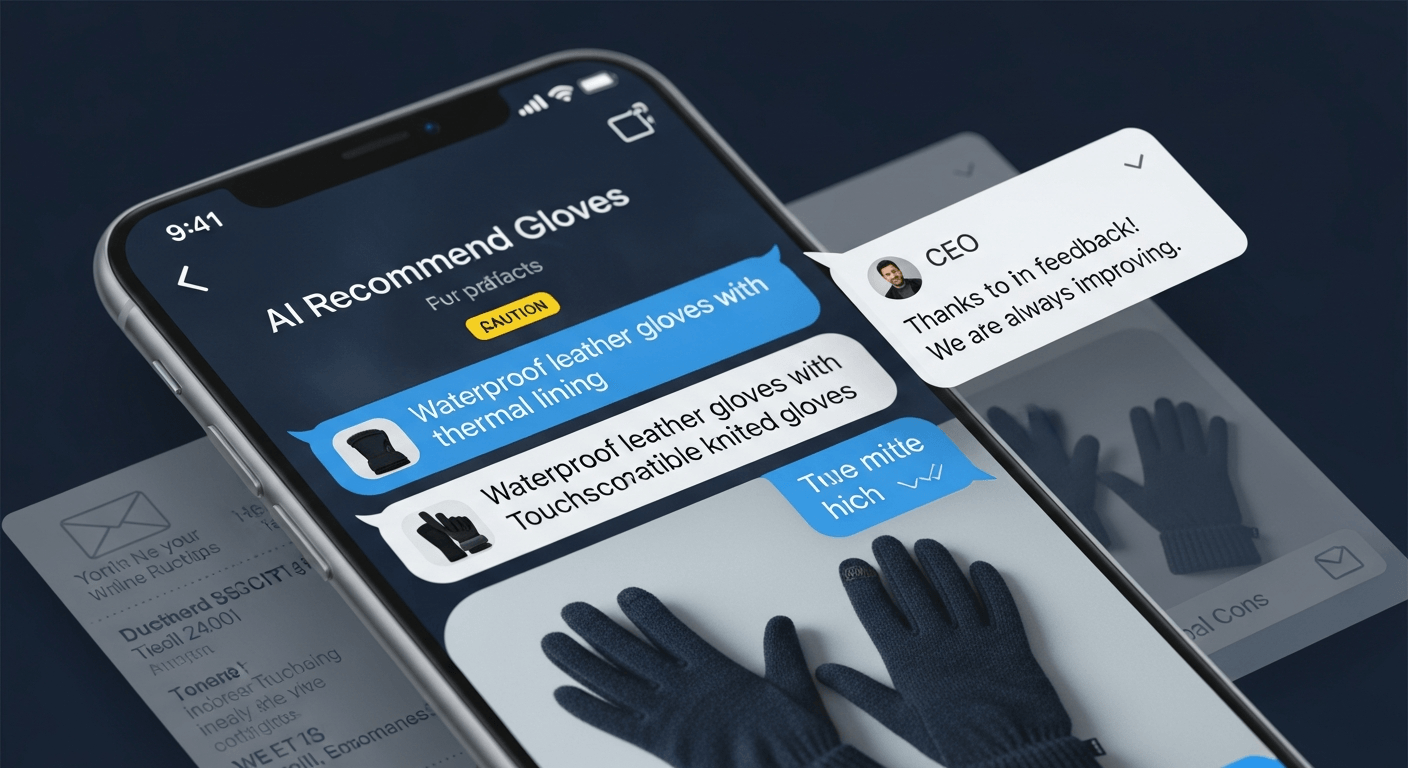
An analyst shared a screenshot showing the Gemini app answering a personal, purchase-related prompt: “Are the gloves I just ordered good for snow?” The assistant retrieved the product name (an Aerynx Winter Gloves order), assessed likely performance — noting water-repellent outer layer, suitability for light snow but not full waterproofing, and recommended using them as liners or for short tasks — and added contextual advice about expected temperature ranges and storm conditions.Read coverage of the exchange.
The analyst who posted the screenshot is Max Weinbach (max@creativestrategies.com). I will refer to his post and the public reaction as the trigger for a broader conversation about how personal assistants use private data and external knowledge to give actionable recommendations.
The CEO of Google publicly responded to the post on social media, framing the interaction as a strong example of the new personalization capabilities in Gemini. That public acknowledgement turned a routine demo into a moment of product signalling from the top.
Background: Gemini and the “Personal Intelligence” shift
Gemini has evolved quickly beyond a standalone chat model into an assistant that can reason across a user’s Google data when the user opts in. Google’s recent Personal Intelligence functionality connects Gemini (with user permission) to Gmail, Photos, Search, YouTube and similar signals so the assistant can retrieve concrete details (an order confirmation, a photo of the product, related reviews) and combine them with general knowledge when answering.
Google’s product blog explains Personal Intelligence as a beta that “reason[s] across complex sources and retriev[es] specific details from, say, an email or photo to answer your question,” shipped initially to eligible Pro/Ultra subscribers in the U.S.Personal Intelligence announcement.
The glove example demonstrates two of the platform’s advertised strengths: precise retrieval (what was ordered, product specs) and synthesis (assessing waterproofing, recommended use cases in different weather). That capability is compelling — and also where the safety and trust trade-offs live.
Why this matters for AI safety and enterprise trust
Three linked concerns stand out to me:
- Grounding and provenance
- When assistants mix personal data with model knowledge, users need to know which part of the answer came from a personal source (order confirmation, photo) and which came from general model inference (typical thermal ratings, waterproofing norms). If a business or individual acts on a mixed answer without clear provenance, the result can be poor outcomes or liability.
- Overreach and false confidence
- A calm, natural language response that sounds confident can mask uncertainty. If Gemini suggests a glove is “a solid choice for moderate cold and light snow,” users may treat that as definitive rather than probabilistic guidance. For enterprise deployments this is a reputational risk: assistants must surface uncertainty and limitations.
- Data access and consent patterns
- Personal Intelligence is opt‑in, but many enterprises will adopt similar models: agents that combine internal documents, emails, and private data with external knowledge. That design can accelerate productivity — and amplify risk if access controls, audit trails, and revocation mechanisms aren’t robust.
Taken together, these factors shape whether organisations and customers will trust an assistant for operational decisions (procurement advice, safety checklists, legal summaries) or treat it as a helpful but fallible aide.
What the CEO’s response signals (and why it matters)
The company’s CEO replied publicly to the analyst’s post and described the example as a positive demonstration of personalization in Gemini. That reaction has at least three implications:
Product prioritisation: leadership attention signals that personalized, cross‑source reasoning is a strategic axis for the product.
Rapid normalization: a top‑level endorsement helps normalize the use of connected assistants in everyday scenarios (shopping, trip planning, household tasks), which accelerates adoption.
Heightened scrutiny: when the CEO highlights a capability, regulators, enterprise buyers, and security teams pay attention. That means faster product rollout comes with faster auditing expectations.
The net is simple: leadership endorsements multiply both adoption and scrutiny.
Practical implications for enterprises and safety teams
If you’re evaluating or building assistants that connect to private data, here are practical points I would emphasise:
Evidence and citation UI: require the assistant to cite the source for any specific factual claim ("pulled from your Gmail order confirmation dated Jan 8").
Uncertainty calibration: use templates that express confidence (e.g., “Likely suitable for light snow; not fully waterproof. Confidence: medium.”).
Access controls & audit logs: show who enabled which integrations and when, and record retrieval events for compliance.
Human-in-the-loop for high-risk advice: for safety- or compliance-critical recommendations, escalate to a human reviewer.
These practices reduce the cognitive load on users and the legal/operational exposure for organisations.
Takeaway
Small, everyday prompts — like “Are these gloves good for snow?” — are the clearest way to see how AI assistants will be used and where they can fail. The episode shows the power of cross‑source personalization and why corporate governance, transparency, and calibrated confidence are essential if these tools are to earn sustained enterprise trust.
Open question for you
- How would you want an assistant to show the sources and confidence behind a product recommendation before you act on it?
Regards,
Hemen Parekh
Any questions / doubts / clarifications regarding this blog? Just ask (by typing or talking) my Virtual Avatar on the website embedded below. Then "Share" that to your friend on WhatsApp.
References
- Coverage of the analyst post and CEO reply: "Analyst uses Gemini for 'snow tips', Google CEO Sundar Pichai responds" (Times of India).
- Google product background: "Personal Intelligence: Connecting Gemini to Google apps" (Google Blog).
Note on the analyst who posted the screenshot: Max Weinbach (max@creativestrategies.com).
Get correct answer to any question asked by Shri Amitabh Bachchan on Kaun Banega Crorepati, faster than any contestant
Hello Candidates :
- For UPSC – IAS – IPS – IFS etc., exams, you must prepare to answer, essay type questions which test your General Knowledge / Sensitivity of current events
- If you have read this blog carefully , you should be able to answer the following question:
- Need help ? No problem . Following are two AI AGENTS where we have PRE-LOADED this question in their respective Question Boxes . All that you have to do is just click SUBMIT
- www.HemenParekh.ai { a SLM , powered by my own Digital Content of more than 50,000 + documents, written by me over past 60 years of my professional career }
- www.IndiaAGI.ai { a consortium of 3 LLMs which debate and deliver a CONSENSUS answer – and each gives its own answer as well ! }
- It is up to you to decide which answer is more comprehensive / nuanced ( For sheer amazement, click both SUBMIT buttons quickly, one after another ) Then share any answer with yourself / your friends ( using WhatsApp / Email ). Nothing stops you from submitting ( just copy / paste from your resource ), all those questions from last year’s UPSC exam paper as well !
- May be there are other online resources which too provide you answers to UPSC “ General Knowledge “ questions but only I provide you in 26 languages !




No comments:
Post a Comment