
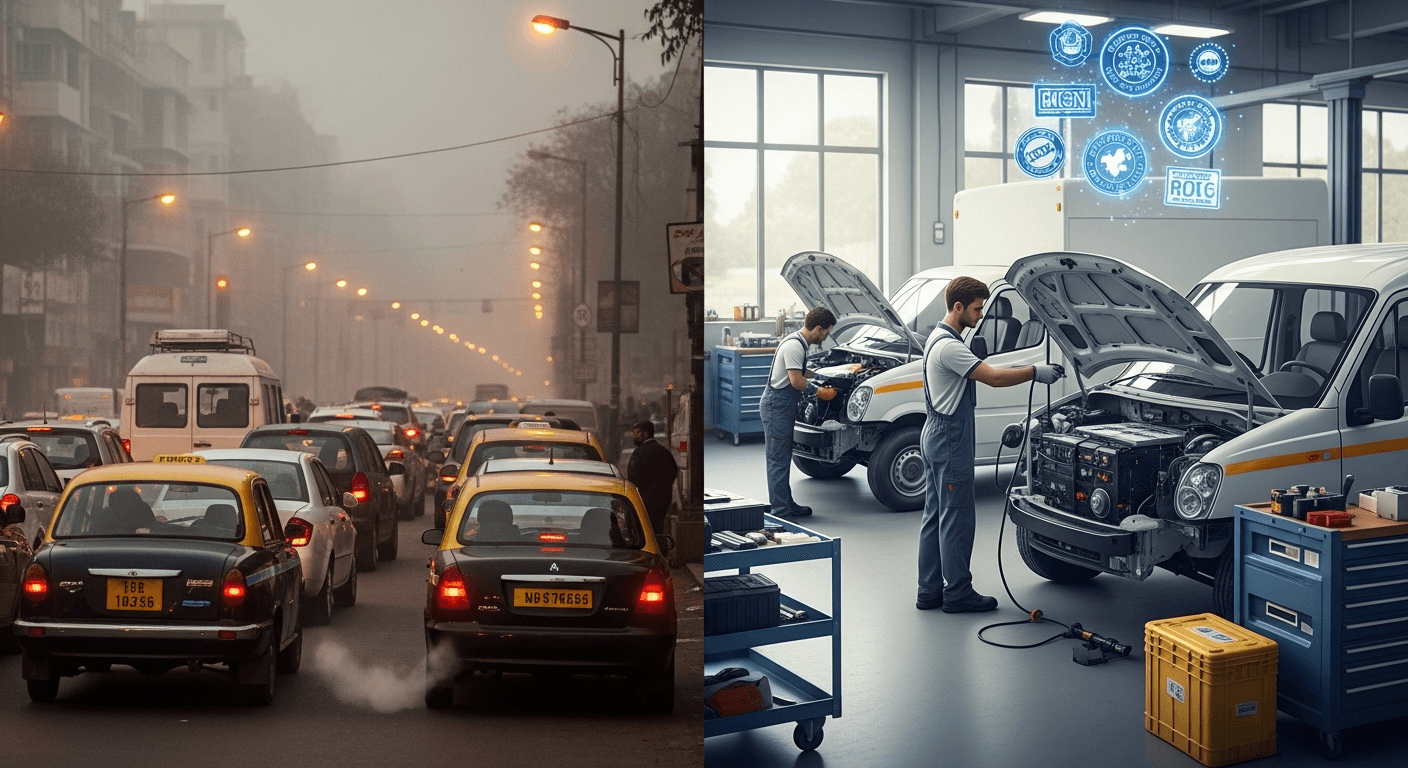
Headline: Delhi’s EV retrofitting push divides the auto industry
Introduction
I’ve been watching Delhi’s renewed push for electric-vehicle (EV) retrofitting with interest because it exposes a central tension in India’s clean-mobility strategy: speed versus system integrity. The idea is simple and tempting — convert older internal-combustion-engine (ICE) vehicles to electric powertrains, keep useful assets on the road and cut tailpipe pollution quickly. The reality is complex. The policy opens opportunity and risk in roughly equal measure.
What Delhi’s policy requires (and offers)
- The draft EV Policy 2.0 under consideration in Delhi proposes targeted incentives for retrofitting — widely reported as a ₹50,000 grant for the first 1,000 vehicles to be converted — and a process to empanel kit manufacturers and authorised centres for conversion and inspection.[1][2]
- Delhi’s existing rules (driven by NGT and court orders) already bar petrol vehicles over 15 years and diesel vehicles over 10 years from plying in the city. Retrofitting is being promoted as a way for those vehicles to remain compliant if converted to electric propulsion and re-registered as EVs.[3]
- The state transport portal also points to a single-window approach for implementing EV measures (charging, empanelment and registration steps) to ease operational bottlenecks.[4]
Which vehicles are targeted and the timelines
- Priority candidates are older petrol (15+ years) and diesel (10+ years) vehicles that would otherwise be barred from Delhi roads. Authorities have signalled special emphasis on commercial segments — light commercial vehicles, taxis and three‑wheelers — where conversions can deliver quick operational savings and ambient-air benefits.[3][5]
- Officials have described the incentive window as limited (the headline ₹50,000 for the first 1,000 retrofits), intended to kick-start the market while the government works on approvals and empanelment. Exact cabinet approvals and roll-out dates were still under consultation at the time of reporting.[2]
Safety concerns raised by unions and trade bodies
- Unions and many OEM-aligned trade bodies stress that EV retrofitting is not a simple fuel-system swap (as CNG/LPG conversions were). Retrofitting alters weight distribution, battery placement, wiring harnesses, high-voltage systems, braking and crash-energy behaviour — all of which can affect vehicle safety if not engineered and certified to strict standards.[1][2]
- The principal safety worries cited by industry voices include battery fire risk, poor high-voltage isolation, inadequate crash protection for batteries, degraded handling due to weight changes, and weak aftermarket servicing and recalls in the event of kit failures.[1]
Perspectives from retrofitters and startups
- Retrofitters and several startups welcome the initiative: it creates market demand, leverages existing manufacturing/aftermarket skills and offers an affordable path to electrification for owners who cannot buy new EVs.[5][6]
- Their practical challenges are clear: kit-level approvals must be faster and broader, GST and subsidy parity with new EVs is needed (retrofitted vehicles often attract higher GST), and authorised installer networks and guarantees are essential to scale commercially.[6]
Business risks for OEMs and fleet operators
- OEMs see two business risks: (a) safety and brand risk if third‑party conversions fail and a converted car bearing a make/model name is involved in an incident; (b) demand-side cannibalisation that could complicate long-term product and service strategies as manufacturers shift to ‘born-electric’ platforms.[1]
- Fleet operators weigh retrofit capital cost versus replacement. Conversion can be cheaper than new EV acquisition for some commercial vehicles: JMK and sector analyses put retrofit kit costs roughly at ₹50k–1lakh for two‑wheelers, ₹1–3 lakh for three‑wheelers and light commercial vehicles, and several lakhs for passenger cars — with paybacks in a few years for high-usage vehicles.[7][8]
Legal and regulatory questions
- Retrofitting is legally permitted under the Central Motor Vehicles Rules via type‑approval pathways and guidelines (AIS/CMVR), but implementation relies heavily on testing agencies (ARAI/ICAT), state RTOs for RC updates, and state transport departments for inspections.[5][9]
- Gaps remain: slow kit approvals, inconsistent RTO capabilities for technical inspections, unclear product-liability chains (who is responsible if a kit fails), and insurance/finance acceptance for retrofitted assets.[5][6]
International comparisons
- Europe: Retrofitting has been used cautiously — more common in buses and municipal fleets under strict homologation and certified installer regimes (France/Germany). Programs focused on fleet conversions offer a precedent for controlled deployment.[5]
- UK/City programs: London has piloted bus retrofit programmes to reduce emissions without wholesale replacement, emphasising certified engineering and central oversight.[5]
- China: Earlier aggressive local retrofitting for taxis/logistics vehicles was time-bound and later scaled back as factory-built EVs became cheaper; regulators tightened standards once domestic EV production matured.[5]
Likely consumer impact and environmental trade-offs
- Consumers: For many owners — especially small businesses and fleet operators — retrofitting is likely to be attractive where conversion cost plus ongoing battery/maintenance assurances undercut the price of a new EV. For private car owners the calculus is more mixed due to cost, warranty and resale issues.[7]
- Environmental trade-offs: Retrofitting reduces tailpipe emissions quickly and can avoid the lifecycle carbon cost of scrapping and replacing vehicles. However, poorly engineered conversions risk increased energy use per kilometre and create battery‑end‑of‑life and grid‑demand pressures that must be managed.[5][7]
Steps to reduce safety and business risks
I believe the debate should move from binary ‘for/against’ to practical risk reduction:
- Faster, well‑resourced kit certification: scale ARAI/ICAT capacity and create regional test labs for type approvals.[5]
- Empanelment and authorised centres: only registered garages with trained technicians should install certified kits; maintain a public registry.[4]
- Insurance and liability frameworks: require manufacturer/kit‑maker insurance and clearly defined product‑liability rules so insurers and financiers can underwrite conversions.[5][6]
- GST/subsidy parity and fiscal nudges: align taxes and incentives so conversions aren’t penalised relative to new EV purchases.[6]
- Focused scope: prioritise two‑wheelers, three‑wheelers, LCVs and municipal fleets where benefits outweigh technical complexity; treat passenger cars with greater caution.[5]
- Post‑conversion monitoring: mandatory periodic inspections and a recall/repair mechanism for retrofitted kits.
Conclusion — key takeaways
- Delhi’s retrofitting push creates a real policy experiment: it can accelerate emissions reductions and preserve value for vehicle owners, but it also exposes safety, regulatory and commercial fault lines.
- The policy’s success depends on rigorous certification, authorised installation networks, insurance clarity, fiscal parity with factory EVs and targeted deployment to vehicle types where conversions make technical and economic sense.
- If Delhi gets the governance architecture right, retrofitting can be a pragmatic bridge in the transition to electric mobility. If it doesn’t, the market risks creating unsafe conversions and brand and financial fallout for OEMs, insurers and consumers.
Sources
- Delhi government policy and portal: Delhi EV policy updates and retrofitting notes (ev.delhi.gov.in).[4]
- Economic Times coverage of Delhi’s incentive proposal and industry reaction.[2]
- Outlook Business and Policy Circle analyses of safety, emissions and international experience.[1][5]
- Industry reports and cost estimates: Primus Partners / JMK Research analyses on retrofit costs and economics.[7][8]
Regards,
Hemen Parekh
Any questions / doubts / clarifications regarding this blog? Just ask (by typing or talking) my Virtual Avatar on the website embedded below. Then "Share" that to your friend on WhatsApp.
Get correct answer to any question asked by Shri Amitabh Bachchan on Kaun Banega Crorepati, faster than any contestant
Hello Candidates :
- For UPSC – IAS – IPS – IFS etc., exams, you must prepare to answer, essay type questions which test your General Knowledge / Sensitivity of current events
- If you have read this blog carefully , you should be able to answer the following question:
- Need help ? No problem . Following are two AI AGENTS where we have PRE-LOADED this question in their respective Question Boxes . All that you have to do is just click SUBMIT
- www.HemenParekh.ai { a SLM , powered by my own Digital Content of more than 50,000 + documents, written by me over past 60 years of my professional career }
- www.IndiaAGI.ai { a consortium of 3 LLMs which debate and deliver a CONSENSUS answer – and each gives its own answer as well ! }
- It is up to you to decide which answer is more comprehensive / nuanced ( For sheer amazement, click both SUBMIT buttons quickly, one after another ) Then share any answer with yourself / your friends ( using WhatsApp / Email ). Nothing stops you from submitting ( just copy / paste from your resource ), all those questions from last year’s UPSC exam paper as well !
- May be there are other online resources which too provide you answers to UPSC “ General Knowledge “ questions but only I provide you in 26 languages !





No comments:
Post a Comment