
Introduction
I write about energy storage because it sits at the intersection of technology, economics and public policy — and because it quietly determines whether our renewables revolution actually delivers clean, reliable power. Over the last two decades we moved from incremental improvements in batteries to purpose-built Battery Energy Storage Systems (BESS) that now act as grid assets. In this piece I trace that journey — “From better to BESS” — and offer a concise technical primer, operational and safety considerations, economic framing, deployment challenges and practical recommendations for policymakers, utilities and developers.
I’ve explored aspects of storage economics and policy before (see my earlier reflections on storage and market design)Green Energy Storage : Preserving a Perishable. What follows builds on that thinking and focuses on the modern BESS stack.
From “better” — incremental improvements — to purpose-built storage
Energy storage did not leap into existence overnight. The industry evolved through several eras:
- Lead‑acid and NiCd/NiMH: the foundational chemistries for backup and telecom, valued for simplicity and low upfront cost but limited cycle life and energy density.
- Lithium‑ion era: improvements in cathode/anode materials, manufacturing scale and pack engineering drove dramatic improvements in energy density, round‑trip efficiency and calendar/cycle life — turning batteries from niche backups into grid assets.
- Power electronics & controls: cheaper, faster inverters and smarter control software converted batteries into dispatchable generation-like assets, enabling services beyond backup (frequency response, arbitrage, ramping).
- Systemization: the move from ad‑hoc racks to containerized, certified systems (mechanical, electrical, fire protection integrated) — the birth of the modern BESS product.
Those incremental gains — better cells, better modules, better power electronics, better controls — combined with falling cell costs created a tipping point: storage became economical for grid services. That’s the moment we properly shifted from “better batteries” to BESS as an engineered system.
What a BESS is today: an architectural view
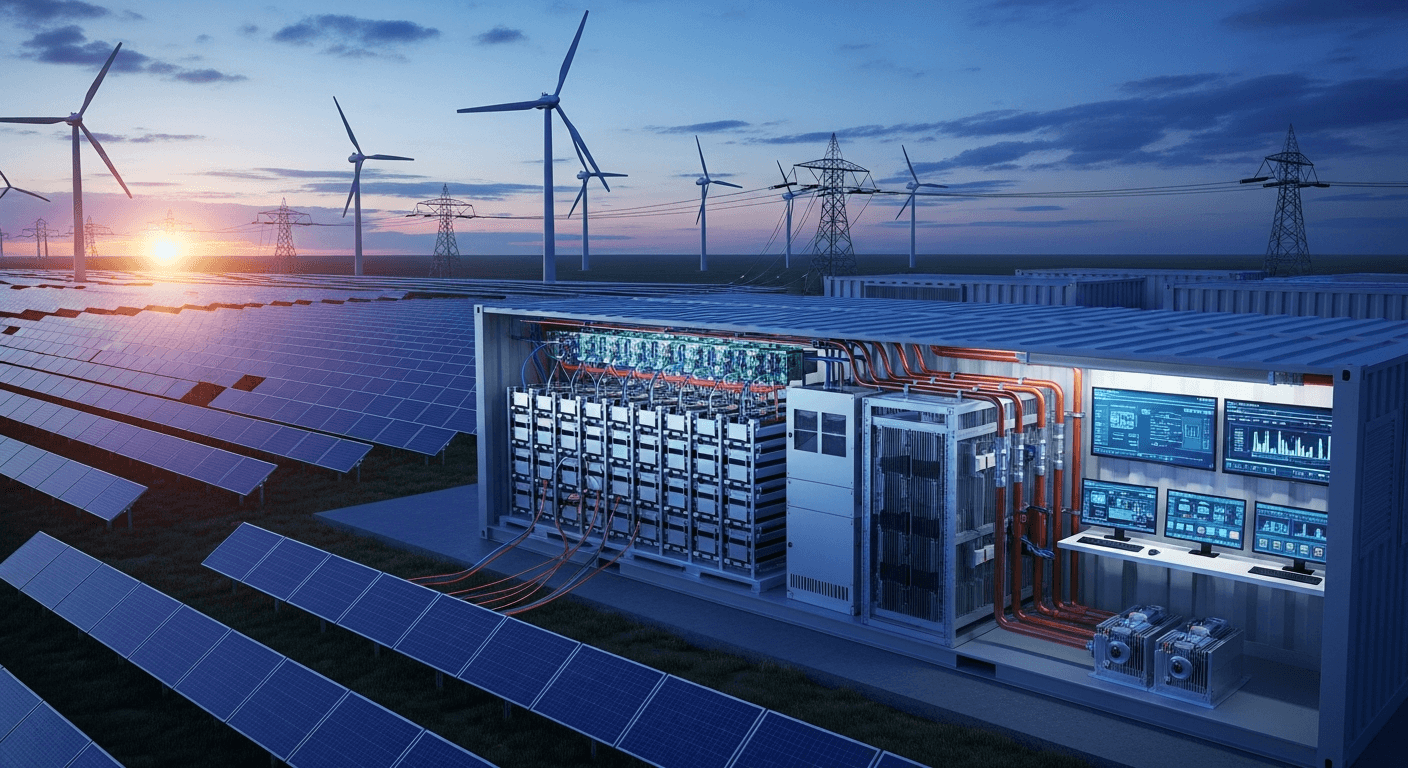
A modern BESS is more than batteries. At a high level it includes:
- Battery modules and packs (cells grouped into modules and racks) — the electrochemical core.
- Battery Management System (BMS) — cell‑level and system‑level management for state-of-charge, state-of-health, balancing, safety interlocks.
- Power Conversion System (PCS) / inverters — convert DC ↔ AC, provide grid interconnection functionality and fast frequency response.
- Balance of Plant (BOP) — HVAC/thermal management, fire detection/venting, breakers, relays, cabling and civil works.
- Energy Management System (EMS) / controls — software for market participation, optimisation, dispatch, and predictive maintenance telemetry.
Each of those components must be engineered to work together; the system-level behavior (safety, performance, lifetime) is a function of that integration.
Technical components — a deeper look
Battery chemistries
- Lithium‑ion (NMC, NCA, LFP): dominant today. LFP (LiFePO4) is growing fast for stationary use because of safety, cycle life and cost stability; NMC/NCA provide higher energy density but with more thermal sensitivity.
- Sodium‑ion: promising low‑cost alternative for long‑duration, grid‑centric applications where energy density is less critical.
- Flow batteries (vanadium, emerging chemistries): decouple energy and power, attractive for long‑duration (>8 h) applications and high cycle life.
- Emerging: solid‑state, metal‑air and other chemistries are under development for improved safety and higher energy density.
Power electronics
- The PCS handles bidirectional power flow, islanding detection, ride‑through, grid‑forming/grid‑following modes and reactive power support. Modern inverters are required to meet interconnection standards (IEEE/IEC) and fast dynamic responses.
Battery Management System (BMS)
- Monitors cell voltages, currents, temperatures, SOC/SOH and enforces safe operating limits. A robust BMS is the primary defense against abusive conditions that lead to thermal events.
Thermal management
- Air cooling, liquid cooling and immersion cooling are used depending on density and site conditions. Effective thermal design reduces degradation and mitigates propagation risk.
Fire, gas and mechanical systems
- Integrated gas detection, smoke detection, explosion prevention (venting/active ventilation), compartmentalisation and suppression strategies are now standard in system design.
Applications and services
BESS is versatile. Common applications include:
- Grid services: frequency regulation, inertial response, and ancillary markets.
- Renewables integration: smoothing, ramping and firming solar and wind generation.
- Microgrids and resilience: black start, islanding and backup for critical loads.
- EV charging integration: peak shaving and capacity management at charging hubs.
- Commercial & industrial: demand charge reduction, energy arbitrage and reliability.
- Distribution deferral and congestion management for utilities.
Revenue stacking — participating in multiple markets simultaneously — is often essential for attractive project returns but increases operational complexity and cycling demands.
Operational and safety considerations
Operational longevity and safe operations are interlinked. Key topics:
- Cycling and degradation: cycle life depends on chemistry, depth-of-discharge, C‑rate, temperature and control strategy. Predictive battery models and smart charging profiles extend life and improve LCOS.
- Thermal runaway and propagation: the industry now treats worst‑case behavior seriously; thermal runaway can propagate from cell → module → rack if not contained.
- Standards and acceptance testing: UL 9540 (system safety), UL 9540A (thermal runaway test method) and NFPA 855 (installation of stationary ESS) are central to permitting and insurance in North America; IEC 62619 and IEC 62933 series are important internationally UL guidance on BESS compliance and policy discussions are reflected in industry overviews and safety guidesCleanPower.org NFPA 855 overview.
- Fire suppression philosophy: modern codes increasingly favour explosion prevention and controlled burn‑out strategies over ineffective suppression for Li‑ion fires; integration with AHJs (Authorities Having Jurisdiction) is essential.
- Cybersecurity & controls: BESS are digital assets; secure communications, firmware governance and SOC controls matter to grid reliability.
Economics: CAPEX, OPEX and value stacking
Project economics revolve around upfront capital cost (CAPEX), operating costs (OPEX), lifetime (cycles and calendar life) and revenue streams. Key metrics:
- Levelized Cost of Storage (LCOS): sum of discounted lifetime costs divided by delivered energy — affected by efficiency, cycle life, round‑trip losses and degradation.
- CAPEX drivers: battery modules, PCS, balance‑of‑plant, civil works and interconnection costs.
- OPEX drivers: maintenance, inverter replacements, insurance, land/lease and eventual recycling or repurposing.
- Revenue streams: energy arbitrage, capacity payments, ancillary services, demand charge reduction and resilience value. Revenue stacking improves returns but increases wear on batteries — operators must balance short-term revenue with long-term asset health.
Deployment challenges
- Siting and permitting: community acceptance, land constraints, local fire code interpretation and AHJ engagement cause timelines to vary widely.
- Interconnection: queue delays, grid studies and upgrade costs can be material.
- Supply chain & recycling: raw material concentration, recycled content and end‑of‑life pathways (recycling and second‑of‑life uses) affect sustainability and circularity.
- Workforce and O&M capability: scalable operations require trained maintenance crews and robust remote monitoring.
Future trends to watch
- Solid‑state and sodium‑ion commercialization for safer and lower‑cost stationary storage.
- Flow batteries gaining ground for long‑duration use cases.
- Virtual BESS and aggregation (VPPs) enabling distributed assets to participate in wholesale markets.
- Second‑life EV batteries repurposed for lower‑stress stationary tasks — careful reconditioning and certification required.
- Hybridisation with hydrogen and other long‑duration storage (power‑to‑gas) for seasonal balancing.
- AI-driven predictive maintenance and digital twins to maximise asset life and reduce unplanned downtime.
Short case study: Harborside Solar + BESS (fictional)
A coastal municipal utility installed a 25 MW / 100 MWh LFP‑based BESS paired with a 40 MW PV plant to reduce evening ramp risk and defer a planned distribution upgrade. Key lessons:
- Chemistry choice (LFP) prioritised safety and cycle life for frequent daily cycling.
- System-level UL 9540A testing data allowed the AHJ to accept simplified fire mitigation (enhanced detection plus ventilation) rather than heavy suppression infrastructure, accelerating permitting.
- Revenue stacking (capacity market + peak shaving + ancillary services) improved utilization but the operator enforced depth‑of‑discharge limits to extend battery life, balancing short‑term income and asset longevity.
Conclusion — actionable recommendations
For policymakers
- Standardise and speed up AHJ guidance by adopting the latest national standards (e.g., NFPA 855 referencing UL 9540/9540A) and publish clear checklist templates to shorten permitting cycles.
- Support recycling infrastructure and incentives for second‑life battery programmes to close material loops.
For utilities
- Treat BESS as an operational asset — invest in EMS, predictive analytics and trained O&M teams rather than one‑off procurements.
- Integrate storage into planning tools (capacity expansion, distribution investments) so storage displaces costly network upgrades where economical.
For project developers
- Start AHJ engagement early and prioritise UL/IEC certifications in procurement to avoid costly redesigns at the site.
- Run realistic revenue‑stacking simulations that include degradation impacts; favour conservative cycling strategies to protect long‑term returns.
The path “from better to BESS” is a transition from component improvements to system‑level engineering and market integration. When we design and operate BESS thoughtfully — accounting for safety, economics and lifecycle impacts — storage delivers not just electricity but resilience and value for the entire system.
Regards,
Hemen Parekh (hcp@recruitguru.com)
Any questions / doubts / clarifications regarding this blog? Just ask (by typing or talking) my Virtual Avatar on the website embedded below. Then "Share" that to your friend on WhatsApp.","generalKnowlegeQuestionOnTheDiscussedTopic":"What are the main trade-offs between lithium-ion (LFP) and flow batteries when selecting a BESS for a 10-hour renewable firming application?","imagePrompt":"High-tech grid landscape at dusk: solar farm and wind turbines feeding a modern containerized BESS compound; cutaway overlay showing battery modules, BMS, PCS/inverter, thermal management pipes and control room screens; color palette cool blues and warm sunset orange; realistic, detailed engineering style, high resolution","base64Image":""}
Get correct answer to any question asked by Shri Amitabh Bachchan on Kaun Banega Crorepati, faster than any contestant
Hello Candidates :
- For UPSC – IAS – IPS – IFS etc., exams, you must prepare to answer, essay type questions which test your General Knowledge / Sensitivity of current events
- If you have read this blog carefully , you should be able to answer the following question:
- Need help ? No problem . Following are two AI AGENTS where we have PRE-LOADED this question in their respective Question Boxes . All that you have to do is just click SUBMIT
- www.HemenParekh.ai { a SLM , powered by my own Digital Content of more than 50,000 + documents, written by me over past 60 years of my professional career }
- www.IndiaAGI.ai { a consortium of 3 LLMs which debate and deliver a CONSENSUS answer – and each gives its own answer as well ! }
- It is up to you to decide which answer is more comprehensive / nuanced ( For sheer amazement, click both SUBMIT buttons quickly, one after another ) Then share any answer with yourself / your friends ( using WhatsApp / Email ). Nothing stops you from submitting ( just copy / paste from your resource ), all those questions from last year’s UPSC exam paper as well !
- May be there are other online resources which too provide you answers to UPSC “ General Knowledge “ questions but only I provide you in 26 languages !



No comments:
Post a Comment