
Introduction
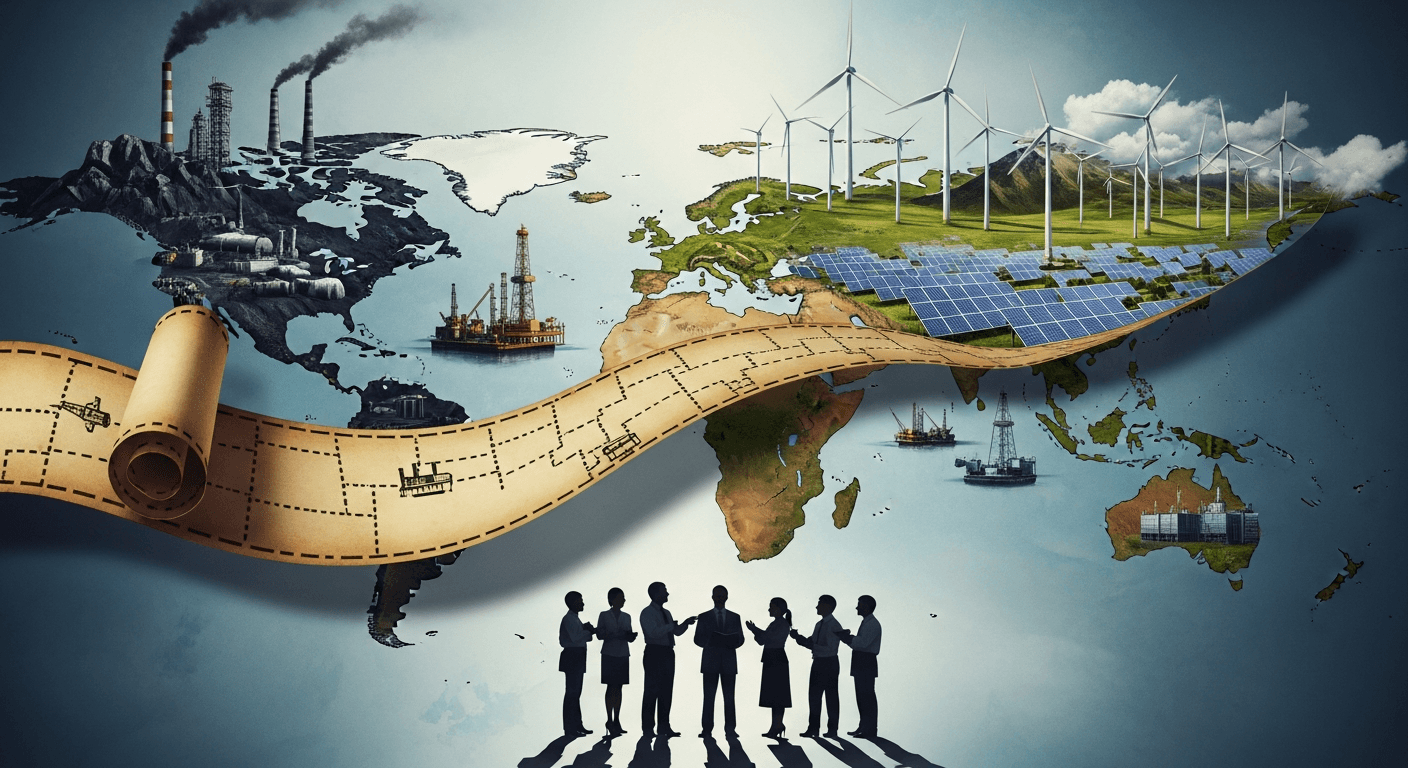
I write this as someone who has watched energy debates move from technical journals into the center of geopolitics and daily life. A global renewable energy body has signaled plans to propose a formal roadmap to transition away from fossil fuels — an initiative that could shift how nations plan energy systems, finance, and social protection in the years ahead. This is not just a technical exercise; it is a political, economic and moral moment. IRENA and other international actors are positioning a practical pathway that seeks to translate high-level COP commitments into implementable steps Economic Times and subsequent convenings have given this effort fresh momentum.
Background and context
The Paris Agreement era pushed countries to set emissions goals; recent COP outcomes (notably COP28 and the discussions at COP30) shifted the language closer to the energy supply itself. That matters because energy accounts for the lion’s share of greenhouse gas emissions, and meaningful progress requires coordination on both demand (efficiency, electrification) and supply (renewables, storage, hydrogen, grid modernization).
Several coalitions of countries and alliances are pressing for a shared roadmap. Political leaders — and negotiation facilitators — are signalling a willingness to develop shared milestones, while also emphasizing the need for a "just, orderly and equitable" approach that recognizes differing national circumstances. Australia’s negotiating role and public statements by some ministers show this is now a multilateral negotiation among coalitions of the willing; for example, Chris Bowen (chris.bowen.mp@aph.gov.au) has been active in lobbying for practical pathways and diplomatic buy-in.
Key components of the proposed roadmap
From the reporting and the technical work already underway, a credible roadmap will likely include these core components:
- Clear, phased milestones: near-term (2026–2030) targets to triple renewables and double energy efficiency rates, medium-term sectoral targets for power, transport and industry, and long-term alignment to net-zero by mid-century.
- Electrification-first pathways: prioritizing electrification of end-uses (transport, buildings, parts of industry) powered by renewables and supported by storage and demand-side management.
- Supply and demand sequencing: coordinated plans to retire or repurpose fossil infrastructure while scaling low-carbon alternatives to avoid energy security gaps.
- Finance and transition support: mechanisms to mobilize public and private capital, de-risk investments in emerging markets, and a fiscal framework to manage stranded-asset risks.
- Social and labour transition measures: reskilling, regional economic diversification, and targeted social protection to support communities reliant on fossil-fuel industries.
- Monitoring, reporting and review: annual syntheses and data-driven progress checks to ensure transparency and course correction.
Potential impacts — economic, social, geopolitical
Economic
- Investment surge in clean infrastructure: the roadmap can unlock predictable pipelines that reduce investor risk, driving deployment and innovation.
- Stranded-asset & fiscal risks: fossil-fuel producers and dependent governments could face revenue shortfalls unless transition finance and economic diversification are robust.
Social
- Job creation and displacement: clean-energy sectors will create jobs, but there will be concentrated displacement in fossil-fuel regions that will require active policy support.
- Energy access equity: the roadmap must prioritize universal access to avoid compounding development gaps.
Geopolitical
- Shifts in strategic leverage: countries dependent on oil and gas exports may seek new alliances or demand compensation/assistance in global negotiations.
- New supply-chain politics: the transition increases strategic importance of critical minerals, manufacturing capacity for renewables and battery technologies, and cross-border grid connections.
Challenges and risks
- Political resistance: fossil-fuel exporting states and economic actors will resist measures that threaten near-term revenue streams.
- Implementation gap: high-level targets without binding delivery mechanisms risk becoming aspirational.
- Financing mismatch: developing countries need concessional financing and de-risking instruments at scale; market finance alone will not suffice.
- Energy security concerns: poorly sequenced retirement of fossil capacity can create price volatility and access issues.
- Equity failures: absent a genuine just-transition architecture, the roadmap could deepen distrust between developed and developing countries.
Recommendations for policymakers
- Anchor the roadmap in practical sequencing: require that supply-side retirements are tied to verified scale-up of low-carbon alternatives and grid flexibility measures.
- Mobilize blended finance and guarantee facilities: create instruments that channel private capital into emerging-market renewables and storage while protecting sovereign balance sheets.
- Embed just-transition packages: link reskilling, regional economic plans, and fiscal buffers to any phase-down commitments to secure political consent.
- Reform subsidies and price signals: begin transparent, staged reform of fossil-fuel subsidies matched with social support and clean-energy incentives.
- Strengthen international cooperation: coordinate critical-minerals policy, cross-border grids and technology transfer to reduce concentration risks.
- Commit to data and accountability: publish annual synthesis reports and independent monitoring to keep momentum and credibility.
Conclusion
A roadmap proposed by a global renewable energy body offers a critical bridge between ambition and delivery. It is an opportunity to replace vague promises with sequenced, financeable, and politically credible steps — provided we pair technical pathways with concrete social and fiscal policies. I have written before about the need to design transitions that combine policy clarity with finance and social fairness my earlier reflections on electrification and transition planning. If done right, the roadmap can be the playbook that helps countries avoid chaotic shocks and instead capture the economic and health benefits of clean energy.
Regards,
Hemen Parekh
Any questions / doubts / clarifications regarding this blog? Just ask (by typing or talking) my Virtual Avatar on the website embedded below. Then "Share" that to your friend on WhatsApp.
Get correct answer to any question asked by Shri Amitabh Bachchan on Kaun Banega Crorepati, faster than any contestant
Hello Candidates :
- For UPSC – IAS – IPS – IFS etc., exams, you must prepare to answer, essay type questions which test your General Knowledge / Sensitivity of current events
- If you have read this blog carefully , you should be able to answer the following question:
- Need help ? No problem . Following are two AI AGENTS where we have PRE-LOADED this question in their respective Question Boxes . All that you have to do is just click SUBMIT
- www.HemenParekh.ai { a SLM , powered by my own Digital Content of more than 50,000 + documents, written by me over past 60 years of my professional career }
- www.IndiaAGI.ai { a consortium of 3 LLMs which debate and deliver a CONSENSUS answer – and each gives its own answer as well ! }
- It is up to you to decide which answer is more comprehensive / nuanced ( For sheer amazement, click both SUBMIT buttons quickly, one after another ) Then share any answer with yourself / your friends ( using WhatsApp / Email ). Nothing stops you from submitting ( just copy / paste from your resource ), all those questions from last year’s UPSC exam paper as well !
- May be there are other online resources which too provide you answers to UPSC “ General Knowledge “ questions but only I provide you in 26 languages !



No comments:
Post a Comment