
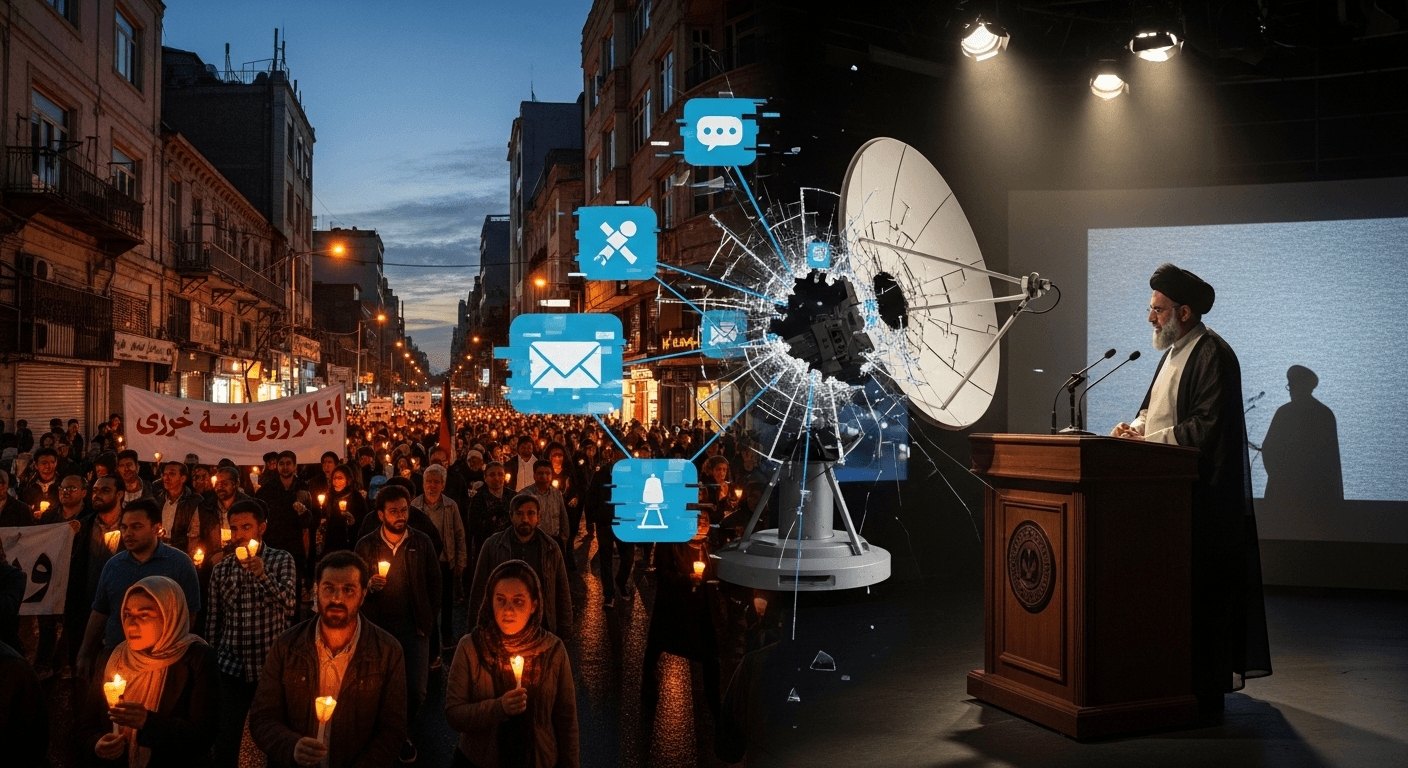
Headline: What's happening in Iran — a short explainer
I’ve been following the reporting closely and wanted to offer a plain-language, neutral account of the crisis unfolding in Iran: how the unrest began, why reports now speak of thousands killed, who is pointing fingers, what the international community is saying, and what plausible next steps look like.
Background: how street unrest became a nationwide crisis
The protests began in late December as demonstrations over severe economic pressures and everyday grievances. In many places the crowds quickly shifted from local economic complaints to political slogans and demands that challenged the ruling system. Security forces responded with a major, coordinated operation: large deployments of riot police, militia units and elements aligned with Iran’s security services. Authorities also imposed a near-total internet shutdown for days, which has made independent reporting and verification extremely difficult.Human Rights Watch and Amnesty International documented widespread use of live ammunition, patterns of mass arrests and accounts from hospitals of overwhelming numbers of wounded.
The casualty figures: why estimates vary so much
Independent verification is limited because of communications blackouts and restricted access. Rights groups that compiled video, hospital and witness material have reported thousands of deaths, while activist networks and some media aggregations have published a range of tallies — from several thousand to much higher estimates — depending on methodology and sources used. State statements have at times acknowledged large numbers of dead but framed the losses as the result of violent infiltrators or foreign-backed elements rather than as the consequence of state use of lethal force.Human Rights Watch report and reporting from independent outlets provide parallel documentation of gunshot wounds, morgue video, and hospital overload that support claims of a very high human toll.
Who is blaming whom
The tone from Tehran’s leadership has sought to shift responsibility away from security services: official statements describe the unrest as the work of armed infiltrators or foreign plots and have explicitly blamed foreign governments for stirring dissent. At the same time, the U.S. administration publicly expressed support for protesters, urged restraint from Iranian authorities, and used strong rhetoric about consequences — even calling for different leadership in Tehran. Those public exchanges have hardened narratives on both sides, with the Iranian state pointing to foreign interference and U.S. officials and Western governments highlighting the scale of state violence and calling for investigations and accountability.Iran International summary and contemporary coverage in outlets such as CBS News and RFE/RL describe this exchange of blame.
International reactions so far
- Human rights organizations and several Western governments have condemned the use of lethal force, called for independent investigations, and urged that detainees be protected.Human Rights Watch and Amnesty International issued strong statements.
- Some regional governments have reiterated concerns about stability and warned of spillover risks.
- Diplomatic steps include summons of Iranian diplomats, targeted sanctions discussions, and expressions of support for human rights monitoring.
Possible scenarios (what could happen next)
I try to keep scenarios grounded and short-term rather than speculative:
Consolidation: the security apparatus further suppresses visible protest through arrests, curfews and local control; the streets appear calmer while underground resistance and diaspora advocacy continue. This is the likeliest immediate outcome if the state maintains cohesion.
Negotiated cooling: limited concessions on economic relief or selective political gestures reduce street mobilization — but without deep reforms this is a temporary easing rather than structural change.
Escalation and regional risk: if military posturing or miscalculation increases (for example around regional bases or incidents involving foreign forces), the crisis could widen, bringing diplomatic and security responses that complicate an already dangerous situation.
Fragmentation of elite control: fractures within security or political elites could create openings for political transition, but that would be disorderly and carry heavy humanitarian and governance risks.
Each path carries serious human, legal and geopolitical implications.
What to watch next (practical indicators)
- Internet and communications: further restrictions or partial restorations will shape what independent investigators and families can document.
- Prisoner/justice actions: watch for mass trials, death sentences or announced pardons — these are immediate signs of the state’s chosen approach.
- Movement of military assets and diplomatic steps: any repositioning of forces in the Gulf or formal emergency sessions at U.N. or regional bodies could signal escalation.
- Independent verification: more authenticated video, hospital lists, or forensic reporting from organizations and journalists will narrow estimates of casualties and guide responses.
A personal note and context
I’ve written before about how international rhetoric and the calculus of leaders can change outcomes in crises; those reflections on strategic interaction and the risks of external intervention remain relevant now (see an earlier piece of mine on geopolitical brinkmanship). Right now my concern — and what I think should concern any reader — is the immediate human cost, the need for independent documentation, and the imperative that outside powers avoid actions that make an already fragile situation worse.
If you want to follow developments, prioritize reputable rights organizations and multiple independent news sources, and be cautious with raw social-media figures until they are corroborated.
Regards,
Hemen Parekh
Any questions / doubts / clarifications regarding this blog? Just ask (by typing or talking) my Virtual Avatar on the website embedded below. Then "Share" that to your friend on WhatsApp.
Get correct answer to any question asked by Shri Amitabh Bachchan on Kaun Banega Crorepati, faster than any contestant
Hello Candidates :
- For UPSC – IAS – IPS – IFS etc., exams, you must prepare to answer, essay type questions which test your General Knowledge / Sensitivity of current events
- If you have read this blog carefully , you should be able to answer the following question:
- Need help ? No problem . Following are two AI AGENTS where we have PRE-LOADED this question in their respective Question Boxes . All that you have to do is just click SUBMIT
- www.HemenParekh.ai { a SLM , powered by my own Digital Content of more than 50,000 + documents, written by me over past 60 years of my professional career }
- www.IndiaAGI.ai { a consortium of 3 LLMs which debate and deliver a CONSENSUS answer – and each gives its own answer as well ! }
- It is up to you to decide which answer is more comprehensive / nuanced ( For sheer amazement, click both SUBMIT buttons quickly, one after another ) Then share any answer with yourself / your friends ( using WhatsApp / Email ). Nothing stops you from submitting ( just copy / paste from your resource ), all those questions from last year’s UPSC exam paper as well !
- May be there are other online resources which too provide you answers to UPSC “ General Knowledge “ questions but only I provide you in 26 languages !


No comments:
Post a Comment