
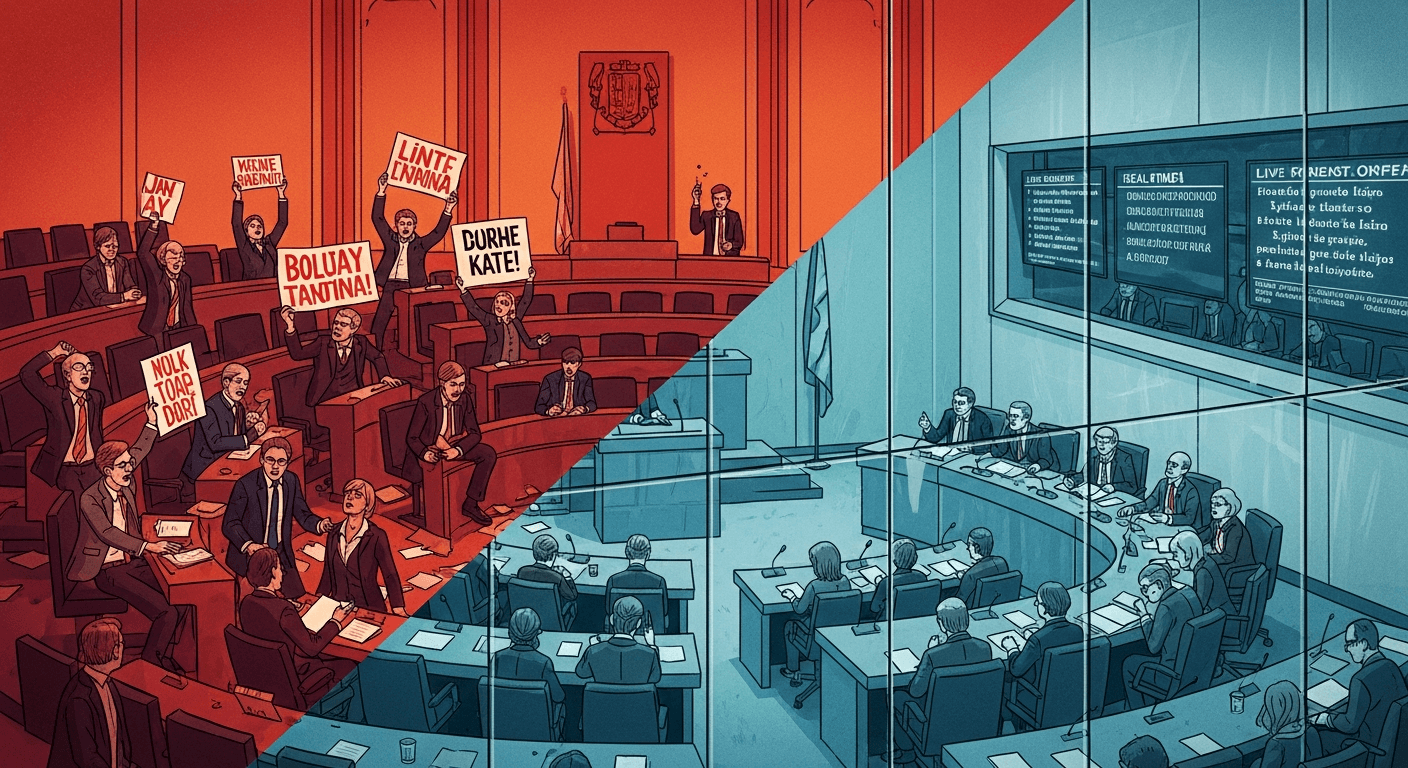
On a House Interrupted
I read the reports this morning about the Speaker publicly condemning repeated disruptions in the legislature. My immediate feeling was a mixture of sympathy for the Chair’s frustration and dismay at the waste: time in the House is public time, and every adjournment or walkout costs citizens—both money and trust.
Why this matters to me
- Our legislatures sit for a surprisingly small number of days each year. With fewer than 100 sitting days in many cycles, every hour ought to be treated as scarce public capital.
- When proceedings devolve into slogan-shouting and placard-waving inside the chamber, debate is replaced by theatre. The net effect: fewer laws debated, committees underused, and constituents left without answers.
- Beyond lost outputs, it erodes dignity and public confidence in representative institutions. Democracy survives on argument, evidence and procedure; when those fray, the whole system becomes less effective.
(For contemporary reporting on the Speaker's remarks, see this news report: Hindustan Times coverage.)
What I’ve said before — and why it still matters
I’ve written about parliamentary deadlocks and practical reforms in the past. Two short reminders from my archive:
- My December 2024 reflection on parliamentary deadlock examined how paralysed sessions waste time and proposed clearer time management for legislative business.
- My 2022 proposal for virtual parliamentary sessions argued that digital tools can reduce chaos and make proceedings more efficient and auditable.
Those ideas were not academic exercises — they were practical attempts to align scarce public time with the scale of problems legislators are meant to solve.
Practical fixes I still believe in
- Use committees seriously
- Strengthen committee work so legislation and oversight happen in sustained, bipartisan forums rather than being frustrated on the floor.
- Publish committee calendars, witness lists and evidence online in advance so public scrutiny becomes real and routine.
- Time-box the floor
- Allocate fixed, enforceable windows for speeches, questions and debates. If a topic requires longer deliberation, it should be deferred to committee or a scheduled special sitting.
- Make decorum digital-friendly
- Pilot hybrid/virtual sittings with controlled audio/video feeds so the Chair has technical levers to maintain order without shutting down entire business.
- Require pre-registration for floor time; make recorded statements or podcasts an accepted alternative for members who follow the rules.
- Translate and broaden access
- Provide live translation and readable transcripts in major regional languages so citizens can follow proceedings and hold representatives to account.
- Increase transparency of lost hours
- Publish daily metrics: scheduled time vs. actual productive time, adjournments and reasons. Let citizens see what was accomplished.
- Incentives and penalties
- Instead of purely symbolic reprimands, create procedural consequences for repeated, deliberate disruptions (e.g., loss of private member time, committee assignments or other internal privileges) — but always within clear, predictable rules to avoid politicisation.
A final thought
Parliamentary theatre has always been part of politics. But when theatre replaces work, the public loses. I’m sympathetic to both the passion of those protesting and the Speaker’s duty to protect the institution. The solutions are not purely disciplinary; they are structural and technical, and they call for leadership that privileges the long-term credibility of our democratic processes.
We have limited time in the House. We should spend it making laws, scrutinising policy and solving problems for the person who needs help at the last mile — not staging scenes that we all regret later.
Regards,
Hemen Parekh
Any questions / doubts / clarifications regarding this blog? Just ask (by typing or talking) my Virtual Avatar on the website embedded below. Then "Share" that to your friend on WhatsApp.
Get correct answer to any question asked by Shri Amitabh Bachchan on Kaun Banega Crorepati, faster than any contestant
Hello Candidates :
- For UPSC – IAS – IPS – IFS etc., exams, you must prepare to answer, essay type questions which test your General Knowledge / Sensitivity of current events
- If you have read this blog carefully , you should be able to answer the following question:
- Need help ? No problem . Following are two AI AGENTS where we have PRE-LOADED this question in their respective Question Boxes . All that you have to do is just click SUBMIT
- www.HemenParekh.ai { a SLM , powered by my own Digital Content of more than 50,000 + documents, written by me over past 60 years of my professional career }
- www.IndiaAGI.ai { a consortium of 3 LLMs which debate and deliver a CONSENSUS answer – and each gives its own answer as well ! }
- It is up to you to decide which answer is more comprehensive / nuanced ( For sheer amazement, click both SUBMIT buttons quickly, one after another ) Then share any answer with yourself / your friends ( using WhatsApp / Email ). Nothing stops you from submitting ( just copy / paste from your resource ), all those questions from last year’s UPSC exam paper as well !
- May be there are other online resources which too provide you answers to UPSC “ General Knowledge “ questions but only I provide you in 26 languages !




No comments:
Post a Comment