
Why this line matters
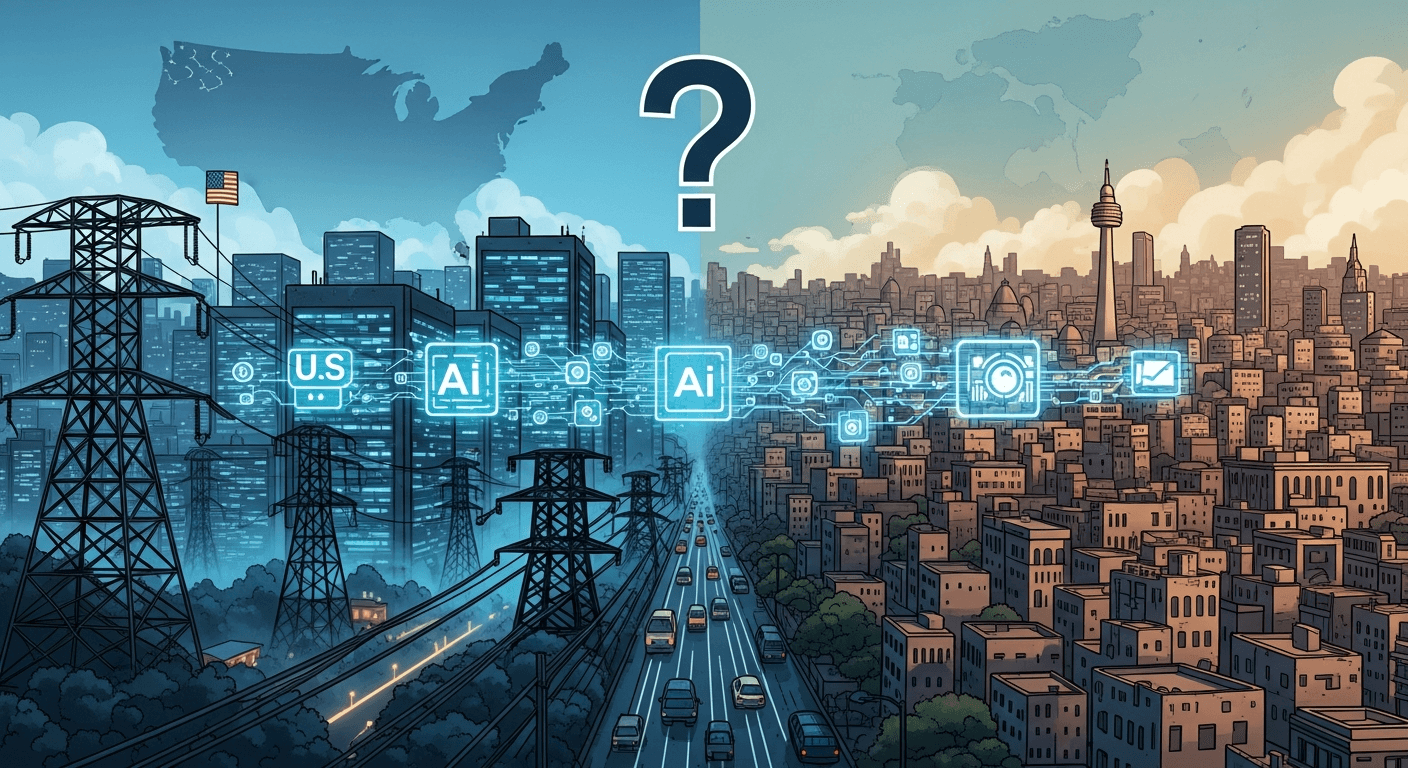
I write this as someone who watches the intersection of policy, technology and trade closely: a recent salvo from a senior White House trade adviser asking, bluntly, why “Americans are paying for AI in India” has gone viral and deserves a sober look. The remark — repeated in interviews and picked up across major outlets — ties together energy, data, trade and geopolitics in one short, provocative sentence. See coverage in India Today and The Indian Express for the original reporting and quotes.[^1][^2]
What the adviser actually said (and where it appeared)
In an interview broadcast on a right-leaning podcast, the trade adviser argued that large AI platforms running on U.S. servers and U.S. electricity were serving millions of users abroad — including in India — and implied that American consumers could be subsidizing those foreign users through higher electricity costs. That quote — “Why are Americans paying for AI in India?” — has been widely reproduced and has become the focal point of a broader argument about where the costs and benefits of AI should land.[^1][^3]
Context on the adviser
nd record (brief, without partisan spin)
The speaker is a senior trade official who served in the last administration, known for hawkish positions on tariffs and trade enforcement. Historically, this office has framed trade disputes through national-security and fairness lenses; the recent comments are an extension of that posture into digital infrastructure and the energy footprint of AI deployment.[^4]
The reality on the ground: infrastructure, outsourcing, and who benefits
A few facts complicate the soundbite:
- AI services are global by design. Models are trained and served across distributed cloud regions; users in one country improve model performance for all. Major outlets have explained how platforms like OpenAI operate on U.S.-based infrastructure while serving global traffic.[^2]
- Data centers consume a lot of electricity, and their growth has pushed some states and regions to negotiate power contracts and plan capacity accordingly. But energy costs are a complex function of local capacity, long-term power purchase agreements, and corporate investment decisions — not simply usage by foreign users.[^5]
- Hiring and outsourcing to India is not the same as “AI being built in India.” India has a huge developer and services workforce that supports product engineering, localization and ops for global companies. At the same time, India is investing in local AI research and hosting its own data center capacity, which changes the calculus over time.[^6]
Why the claim resonates politically
There are three reasons the line landed hard:
- It reframes digital services as tradeable goods with “costs” that should be subject to national policy.
- It taps into a broader strain of economic nationalism: the idea that strategic industries (energy, semiconductors, AI) should produce domestic jobs and domestic benefits.
- It feeds into existing bilateral friction over tariffs, energy imports and market access that has already strained relations with important partners.
Where the claim misleads or simplifies
- Attribution of electricity costs to foreign users overstates the causal link. Data center growth affects grid planning, but the drivers include corporate decisions about where to build capacity, capacity auctions, and local regulatory regimes.
- “Paying for AI in India” implies a one-way subsidy; in practice, global usage helps improve models, spurs local product-market fit, and creates revenue opportunities for platform companies — benefits that accrue unevenly but are not solely borne by U.S. consumers.
- The statement conflates three distinct policy levers: trade policy (tariffs), energy policy (grid planning and PPAs), and digital policy (data flows and localization). Each requires different tools and tradeoffs.
Balanced take: what should policymakers do next
Policymakers should avoid blunt rhetorical gestures and instead:
- Measure the problem. Commission studies on the impact of AI data-center growth on local electricity prices and grid reliability.
- Use targeted policy tools. Where energy constraints exist, prioritize capacity investments, incentivize clean power procurement for data centers, and negotiate regional planning with utilities.
- Treat digital cross-border flows as mutual opportunity. Work with partners to ensure investment, IP protection and joint research, while addressing legitimate national-security concerns.
My perspective and continuity with prior thinking
I’ve argued before that India should be seen as a partner in co-developing AI and that building local capabilities — not just labor arbitrage — is the strategic path forward.[^7] The current exchange illustrates exactly why: countries will jostle over the rules that govern AI’s infrastructure and benefits. We should respond by building institutions and partnerships that align incentives rather than stoking zero-sum narratives.
Implications for U.S. tech policy and politics
The immediate political payoff for sharpened rhetoric is real: it plays well domestically for audiences concerned about jobs and strategic competition. But from a policy standpoint, simplistic framing risks misdirecting solutions. Good outcomes will come from granular energy and industrial policy, international coordination on data and AI standards, and clearer incentives for companies to locate strategic capex where it makes sense for both national security and economic growth.
In short: the question “Who pays?” is valid. The breathless framing that suggests an obvious villain — or a single fix — is not. We need measurement, targeted policy, and international cooperation.
Regards,
Hemen Parekh
Any questions / doubts / clarifications regarding this blog? Just ask (by typing or talking) my Virtual Avatar on the website embedded below. Then "Share" that to your friend on WhatsApp.
Get correct answer to any question asked by Shri Amitabh Bachchan on Kaun Banega Crorepati, faster than any contestant
Hello Candidates :
- For UPSC – IAS – IPS – IFS etc., exams, you must prepare to answer, essay type questions which test your General Knowledge / Sensitivity of current events
- If you have read this blog carefully , you should be able to answer the following question:
- Need help ? No problem . Following are two AI AGENTS where we have PRE-LOADED this question in their respective Question Boxes . All that you have to do is just click SUBMIT
- www.HemenParekh.ai { a SLM , powered by my own Digital Content of more than 50,000 + documents, written by me over past 60 years of my professional career }
- www.IndiaAGI.ai { a consortium of 3 LLMs which debate and deliver a CONSENSUS answer – and each gives its own answer as well ! }
- It is up to you to decide which answer is more comprehensive / nuanced ( For sheer amazement, click both SUBMIT buttons quickly, one after another ) Then share any answer with yourself / your friends ( using WhatsApp / Email ). Nothing stops you from submitting ( just copy / paste from your resource ), all those questions from last year’s UPSC exam paper as well !
- May be there are other online resources which too provide you answers to UPSC “ General Knowledge “ questions but only I provide you in 26 languages !




No comments:
Post a Comment