
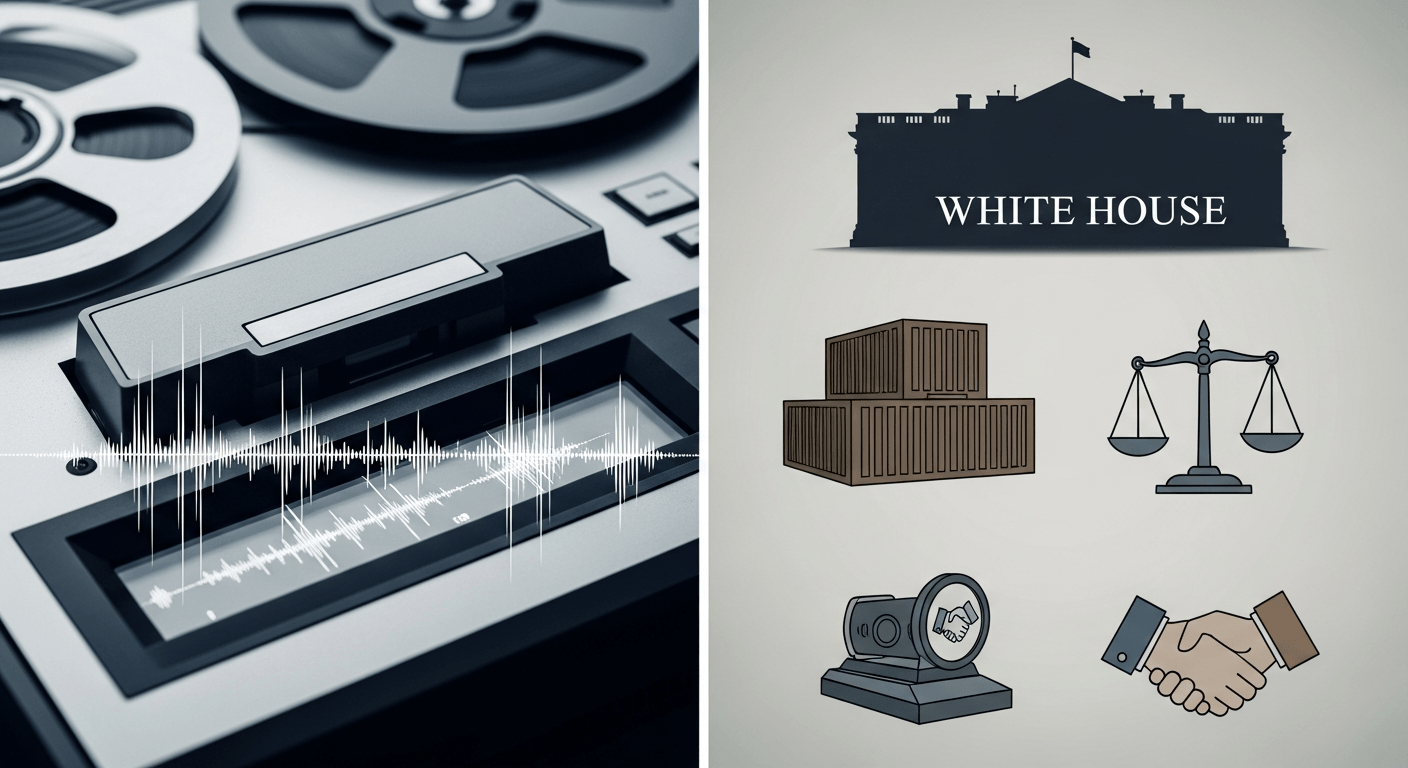
Leaked Audio: Who Stalled the Deal?
I keep returning to the same question when I read accounts of the recently circulated audio about the stalled India–U.S. trade talks: what does a roughly 10‑minute private conversation reveal about policy causes — and what does it conceal?
What the reports say (briefly)
Major outlets report that in private donor conversations, a senior Republican senator described internal White House resistance to a bilateral trade agreement with India, pointing to the influence of a White House economic adviser and the administration’s trade instincts. The core reporting is anchored in an Axios piece that obtained and summarized the recordings and was amplified across other outlets Axios.
Among the named officials those reports single out is Peter Navarro (pvnavarr@uci.edu) — a figure long associated with protectionist trade thinking — and what the reporting describes as resistance from the vice‑presidential office and other White House actors. The consequence, according to those accounts, is friction that has slowed or complicated movement on a formal India–U.S. bilateral trade agreement.
My first reaction: a short audio clip — even a credible one — is a narrow window into a much larger bargaining tableau. It can be illuminating about personalities and tensions, but it is not a transcript of every meeting, nor a comprehensive policy paper.
How to read the leak without jumping to conclusions
- Evidence versus attribution: the audio (as described in reporting) records private opinion and frustration. It is useful as a lead but not definitive proof that any single individual "blocked" a deal.
- Incentives matter: political actors publicly push narratives that help their constituencies — donors, voters, or geopolitical partners. Private remarks to donors can be strategic positioning as much as candid confession.
- Policy complexity: trade agreements are negotiated across agencies, with input from commerce, national security, agriculture, and political leadership. Delays commonly reflect technical, economic, or geopolitical tradeoffs — not only personal objections.
Why this matters for India and global trade
- Risk of over‑personalising: If the public story becomes that a named advisor alone stalled the deal, it risks obscuring legitimate policy debates about tariffs, market access, and geopolitical alignment.
- Markets and diplomacy: uncertainty feeds delays. Firms and policymakers in India and the U.S. need predictable frameworks; leaks amplify uncertainty.
- Domestic politics: reported disagreements inside an administration influence not only trade negotiators but also Congressional calculus on ratification and parity of concessions.
My read — cautious and practical
I believe the reporting is worth taking seriously as a signal of intra‑administration friction. But a measured response is necessary:
- For journalists: corroborate — seek full context and documentation beyond excerpts.
- For policymakers: use the moment to clarify process, re‑frame technical sticking points, and reduce the space for personality‑driven paralysis.
- For Indian stakeholders: separate diplomatic outreach from domestic political theatre; keep negotiations grounded in economic deliverables rather than soundbites.
I have long written about how tariff choices and political positioning reshape trade outcomes — see some of my older reflections on tariffs and revenue frameworks (JAM tariff and revenue‑sharing). The current episode is a reminder that trade diplomacy requires both technical competence and political coordination.
Regards,
Hemen Parekh
Any questions / doubts / clarifications regarding this blog? Just ask (by typing or talking) my Virtual Avatar on the website embedded below. Then "Share" that to your friend on WhatsApp.
Get correct answer to any question asked by Shri Amitabh Bachchan on Kaun Banega Crorepati, faster than any contestant
Hello Candidates :
- For UPSC – IAS – IPS – IFS etc., exams, you must prepare to answer, essay type questions which test your General Knowledge / Sensitivity of current events
- If you have read this blog carefully , you should be able to answer the following question:
- Need help ? No problem . Following are two AI AGENTS where we have PRE-LOADED this question in their respective Question Boxes . All that you have to do is just click SUBMIT
- www.HemenParekh.ai { a SLM , powered by my own Digital Content of more than 50,000 + documents, written by me over past 60 years of my professional career }
- www.IndiaAGI.ai { a consortium of 3 LLMs which debate and deliver a CONSENSUS answer – and each gives its own answer as well ! }
- It is up to you to decide which answer is more comprehensive / nuanced ( For sheer amazement, click both SUBMIT buttons quickly, one after another ) Then share any answer with yourself / your friends ( using WhatsApp / Email ). Nothing stops you from submitting ( just copy / paste from your resource ), all those questions from last year’s UPSC exam paper as well !
- May be there are other online resources which too provide you answers to UPSC “ General Knowledge “ questions but only I provide you in 26 languages !



No comments:
Post a Comment