
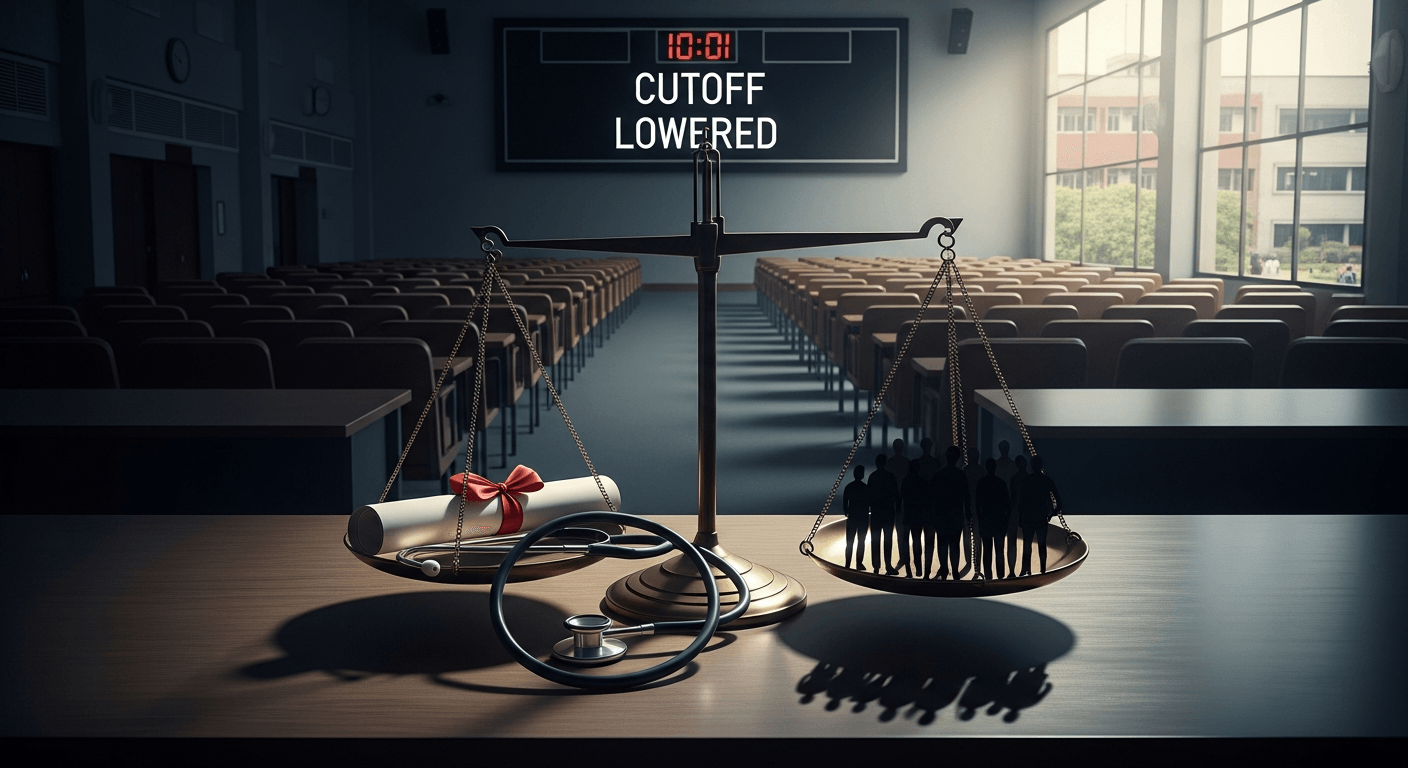
Why the NEET‑PG cut‑off fight matters to me
I read the recent coverage closely — the Centre says NEET‑PG is a ranking exercise and that lowering the qualifying percentile is a pragmatic way to fill thousands of vacant postgraduate seats; the Supreme Court has signalled it will examine whether that move damages the quality of specialist medical education NEET‑PG cut‑off row: Exam doesn't certify competence, says Centre; SC says will examine impact on quality.
I have been writing about the structural pressures in our medical education system for years — the same themes recur: too few incentives to take up postgraduate training in certain places, the fragility of hospital staffing models that rely heavily on residents, and the policy temptation to solve shortages by lowering thresholds rather than fixing root causes (NEET : Reducing Cut Off marks won’t help).
What the policy change actually does
- It expands eligibility for counselling by sharply reducing the minimum qualifying percentile. Authorities say the move is intended to reduce the number of vacant seats — including in government teaching hospitals that depend on PG residents for both training and service.
- Officials argue that clinical competence is certified by the MBBS degree and by supervised postgraduate training and final exit examinations; the exam, they say, primarily creates an inter‑se merit list.
These are not trivial claims. They rest on two propositions:
- MBBS training + internship guarantee a minimum clinical baseline; and
- Postgraduate training under supervision will correct any performance gaps that a lower cut‑off might permit.
Both propositions have merit — but both also deserve scrutiny when applied at scale.
My concerns (and why they are practical, not only academic)
- Systems shape behaviour. When eligibility is expanded abruptly, many institutions — especially private colleges — may use lower cutoffs to admit candidates who pay higher fees. This risks creating perverse incentives that reward capacity to pay rather than potential to learn.
- Supervision and mentorship are variable. A postgraduate seat in a well‑staffed tertiary hospital offers far richer guided learning than one in an understaffed centre. Simply admitting more candidates does not guarantee high‑quality supervised experience everywhere.
- Patient safety and public trust are long‑term assets. Even if MBBS confers a baseline licence to practice, the public expects postgraduate specialists to emerge from rigorous, meritocratic pipelines. Repeated, ad‑hoc lowering of thresholds degrades that expectation over time.
- Governance by last‑minute fixes becomes the norm. Policy nudges that solve the visible vacancy today can defer the harder work: improving working conditions, faculty numbers, rural posting incentives, and regulation of fee structures.
What a responsible response looks like
If we treat the vacancy problem as a symptom rather than an inexorable justification for lowering standards, a multi‑pronged response becomes possible:
Short term (to avoid clinical gaps):
Transparent, time‑bound use of expanded eligibility tied to clear safeguards (e.g., mandatory supervision ratios, publicly published residency mentorship plans).
Transparent seat‑filling rules that prevent arbitrary fee‑driven admissions in private institutions.
Medium term (to sustain training quality):
Invest in faculty recruitment and retention so every PG seat guarantees experienced supervision.
Strengthen internship and foundation‑year programs with standardized assessment checkpoints before specialists are entrusted with independent responsibility.
Use conditional incentives (scholarships, service bonds, rural incentives) to attract high‑quality candidates to underserved seats rather than lowering entry standards.
Long term (to fix supply and demand):
Rationalise seat distribution and build teaching capacity where health needs are greatest.
Make postgraduate training pathways attractive — reasonable pay, career progression, research and teaching opportunities — so vacancies shrink for reasons other than cut‑off changes.
A pragmatic ethic we need to keep
I accept that policy sometimes has to choose the lesser evil: an empty government hospital bed is a real short‑term harm. But we must avoid turning emergency measures into the permanent architecture of medical education.
A robust system protects patients and learners together. That means transparency about why thresholds change, measurable safeguards when they do, and parallel investments to make those exceptions unnecessary.
Final thought
The NEET‑PG debate is less about a single percentile and more about how a society values the delicate nexus between competence, training, and care. If we are serious about securing the next generation of doctors, we must pair emergency fixes with accountable reforms. Only then will lowering a cutoff ever be justifiable as a true bridge — not a shortcut — to better healthcare.
Regards,
Hemen Parekh
Any questions / doubts / clarifications regarding this blog? Just ask (by typing or talking) my Virtual Avatar on the website embedded below. Then "Share" that to your friend on WhatsApp.
Get correct answer to any question asked by Shri Amitabh Bachchan on Kaun Banega Crorepati, faster than any contestant
Hello Candidates :
- For UPSC – IAS – IPS – IFS etc., exams, you must prepare to answer, essay type questions which test your General Knowledge / Sensitivity of current events
- If you have read this blog carefully , you should be able to answer the following question:
- Need help ? No problem . Following are two AI AGENTS where we have PRE-LOADED this question in their respective Question Boxes . All that you have to do is just click SUBMIT
- www.HemenParekh.ai { a SLM , powered by my own Digital Content of more than 50,000 + documents, written by me over past 60 years of my professional career }
- www.IndiaAGI.ai { a consortium of 3 LLMs which debate and deliver a CONSENSUS answer – and each gives its own answer as well ! }
- It is up to you to decide which answer is more comprehensive / nuanced ( For sheer amazement, click both SUBMIT buttons quickly, one after another ) Then share any answer with yourself / your friends ( using WhatsApp / Email ). Nothing stops you from submitting ( just copy / paste from your resource ), all those questions from last year’s UPSC exam paper as well !
- May be there are other online resources which too provide you answers to UPSC “ General Knowledge “ questions but only I provide you in 26 languages !




No comments:
Post a Comment