
Introduction
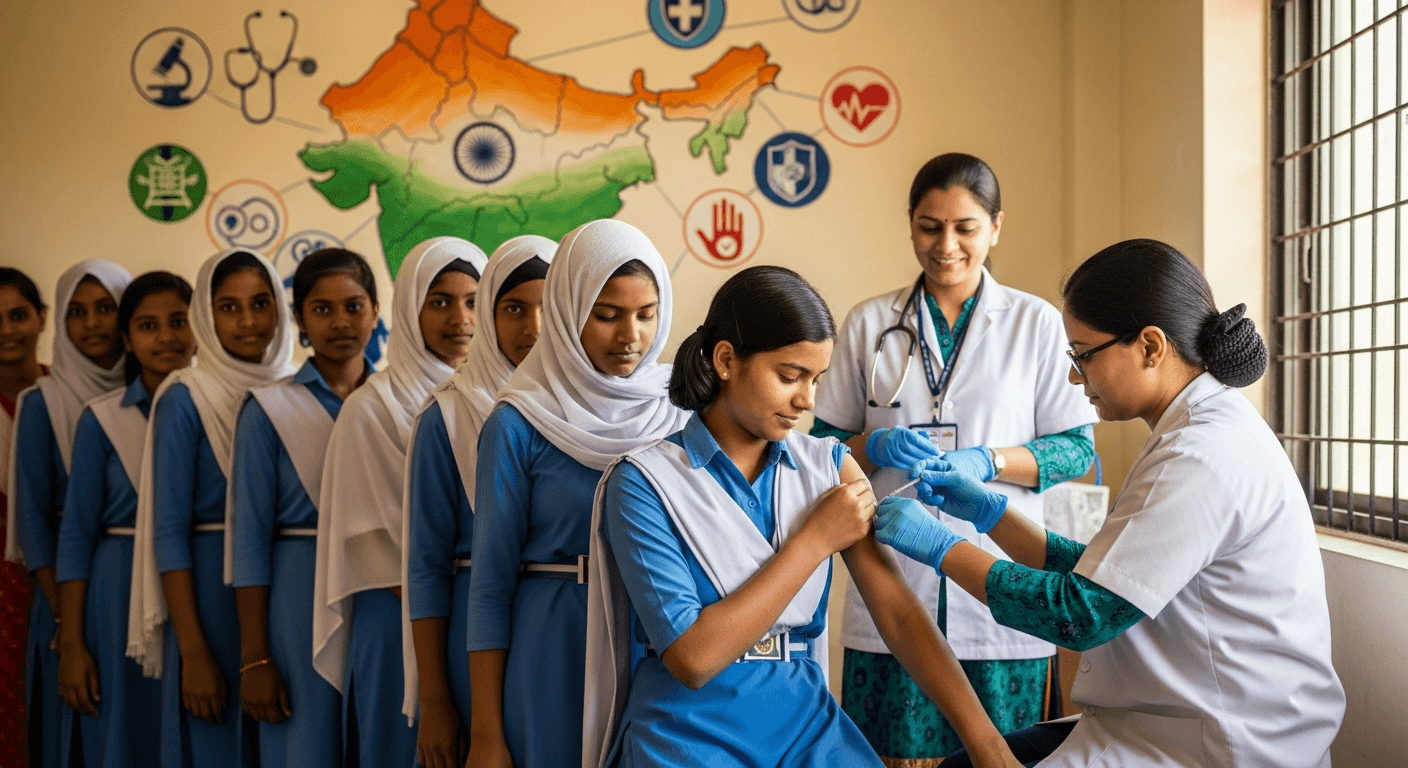
I write today as someone who has long watched how public-health decisions ripple through families, schools and communities. India’s decision to offer free nationwide HPV vaccination to adolescent girls is one of those rare policy moments where prevention, science and social equity converge. It is practical, evidence-based, and — if implemented well — could prevent tens of thousands of needless deaths decades from now.
Why this matters: HPV and cervical cancer (background)
Human papillomavirus (HPV) is a very common virus. A small number of high-risk HPV types (notably HPV-16 and HPV-18) cause the majority of cervical cancers. Cervical cancer is largely preventable through two pillars of public health: vaccination against HPV and screening to detect precancerous changes early.
- Globally, cervical cancer caused hundreds of thousands of deaths every year; India accounts for a disproportionate share of that burden (roughly 120–130k new cases and ~80k deaths annually in recent estimates) [WHO/IARC].
- The World Health Organization (WHO) now supports one- or two-dose HPV schedules for girls aged 9–14 based on accumulating trial data that a single dose provides strong, durable protection [WHO].
(For scientific summaries, see WHO and IARC materials on cervical cancer and the durability of single-dose protection.)
The programme: who, what, when, where, how
- Who: The campaign targets girls around the adolescent window (the government has prioritized girls aged 14 for the inaugural nationwide drive, with the eligible cohort numbering roughly 1.1–1.2 crore girls each year).
- What: Free HPV vaccine (Gardasil [quadrivalent] has been widely reported as the vaccine of choice for the national campaign, with domestic options such as Cervavac also in use during phased rollouts).
- When: The government launched the drive in mission mode with a concentrated campaign period followed by routine availability; initial national launch events and a three-month intensive push were reported at the national launch [Press Information Bureau].
- Where: Designated government health facilities across States and Union Territories — primary health centres, community health centres, district hospitals and government medical colleges — plus school-based outreach where feasible.
- How: Voluntary vaccination with informed parental/guardian consent; sessions are to be supervised by trained medical teams, linked to cold-chain points and AEFI (Adverse Events Following Immunisation) management systems. Digital tracking systems (akin to those used for other national immunisation drives) will help monitor coverage.
Sources and official details are available from the Government of India press releases and Ministry communications [PIB], as well as coverage in national media.
Benefits and expected impact
- Direct prevention: Vaccinating girls before exposure to HPV prevents the infections that can later lead to cervical cancer. Modeling and long-term data show vaccination can reduce cervical cancer incidence dramatically over decades.
- Population impact: If scaled toward WHO targets (90% of girls vaccinated by age 15), India could markedly reduce cervical cancer incidence and mortality and move closer to elimination goals set by WHO/IARC.
- Equity: A free, public programme removes a major financial barrier — private doses can be prohibitively expensive for many families.
Scientific evidence — including long-term cohort and randomized studies summarized in peer-reviewed journals (Lancet Oncology and other reports) — supports strong efficacy for vaccine schedules, including single-dose strategies in young adolescents [Lancet Oncol; WHO/IARC].
Potential challenges and practical solutions
- Supply and cold chain logistics: Delivering millions of doses across diverse geographies requires robust cold chain management and last-mile tracking. Solution: reuse and scale digital vaccine logistics platforms (like those refined during COVID rollouts) and prioritize early training for state and district cold-chain managers.
- Vaccine hesitancy and misinformation: Concerns about safety, fertility myths, and the sexual-transmission stigma around HPV can reduce uptake. Solution: clear, culturally sensitive communication campaigns (school plus community leaders), and transparent AEFI monitoring to build trust.
- Documentation and consent: Ensuring informed parental consent while avoiding administrative barriers. Solution: simple consent forms in local languages and school-based parental engagement meetings.
I have written earlier about vaccination logistics and the need for strong IT and last-mile planning in vaccine rollouts; those reflections remain relevant today (see my piece on vaccination planning and delivery)Voting and Vaccination: Compare and Contrast.
Illustrative quotes (hypothetical)
"This campaign changes the future for an entire generation — it is prevention at scale." — Public health official (illustrative)
"As a parent, I want my daughter protected from a cancer she may never see coming." — Parent (illustrative)
(These are illustrative quotes meant to capture the common sentiments one hears from health professionals and families; they are not attributions to specific individuals.)
Guidance for parents and adolescents
- Eligibility: Check local announcements, but the national campaign prioritised girls in the 9–14/14-year cohort during the launch phase. Some states may offer catch-up windows.
- Safety: HPV vaccines have been administered to hundreds of millions globally. Large trials and post-marketing surveillance show a reassuring safety profile; common side effects are mild (soreness at injection site, low-grade fever). Severe reactions are rare and health centres are prepared to manage AEFI.
- Side effects and follow-up: Expect soreness, occasional fever or nausea. Stay for the recommended observation period at the clinic (usually 15–30 minutes). Report any worrying reactions to the administering centre.
- Where to get vaccinated: Designated government facilities during the campaign; afterwards, routine immunisation days at government clinics. Schools may host sessions during the campaign — check state or district health bulletins.
Call to action
If you are a parent or caregiver: check with your local health centre or school for dates, carry basic ID or school documents to verify age, and provide informed consent. If you are a teacher, community leader, or health worker: help spread evidence-based information and help families access the service.
Conclusion
This programme is a profound act of preventive care: inexpensive vaccines today that avert suffering many years from now. India’s free HPV vaccine rollout can close a gap in health equity and move the country closer to the WHO goal of eliminating cervical cancer as a public-health problem. Implementation will be the test — but the scientific case for vaccination is strong and the human case is clearer still.
Selected references and further reading
- Government of India, Press Information Bureau: Nationwide HPV vaccination programme launch and details PIB press release.
- World Health Organization: One-dose HPV vaccine recommendation and cervical cancer elimination strategy WHO news and IARC/WHO country briefs.
- Basu P., Malvi S.G., Joshi S., et al., Lancet Oncology (2021) — studies on single-dose immunogenicity and long-term follow-up for quadrivalent vaccine [see Lancet Oncol DOI: 10.1016/S1470-2045(21)00453-8].
Regards,
Hemen Parekh
Any questions / doubts / clarifications regarding this blog? Just ask (by typing or talking) my Virtual Avatar on the website embedded below. Then "Share" that to your friend on WhatsApp.
Get correct answer to any question asked by Shri Amitabh Bachchan on Kaun Banega Crorepati, faster than any contestant
Hello Candidates :
- For UPSC – IAS – IPS – IFS etc., exams, you must prepare to answer, essay type questions which test your General Knowledge / Sensitivity of current events
- If you have read this blog carefully , you should be able to answer the following question:
- Need help ? No problem . Following are two AI AGENTS where we have PRE-LOADED this question in their respective Question Boxes . All that you have to do is just click SUBMIT
- www.HemenParekh.ai { a SLM , powered by my own Digital Content of more than 50,000 + documents, written by me over past 60 years of my professional career }
- www.IndiaAGI.ai { a consortium of 3 LLMs which debate and deliver a CONSENSUS answer – and each gives its own answer as well ! }
- It is up to you to decide which answer is more comprehensive / nuanced ( For sheer amazement, click both SUBMIT buttons quickly, one after another ) Then share any answer with yourself / your friends ( using WhatsApp / Email ). Nothing stops you from submitting ( just copy / paste from your resource ), all those questions from last year’s UPSC exam paper as well !
- May be there are other online resources which too provide you answers to UPSC “ General Knowledge “ questions but only I provide you in 26 languages !


No comments:
Post a Comment