
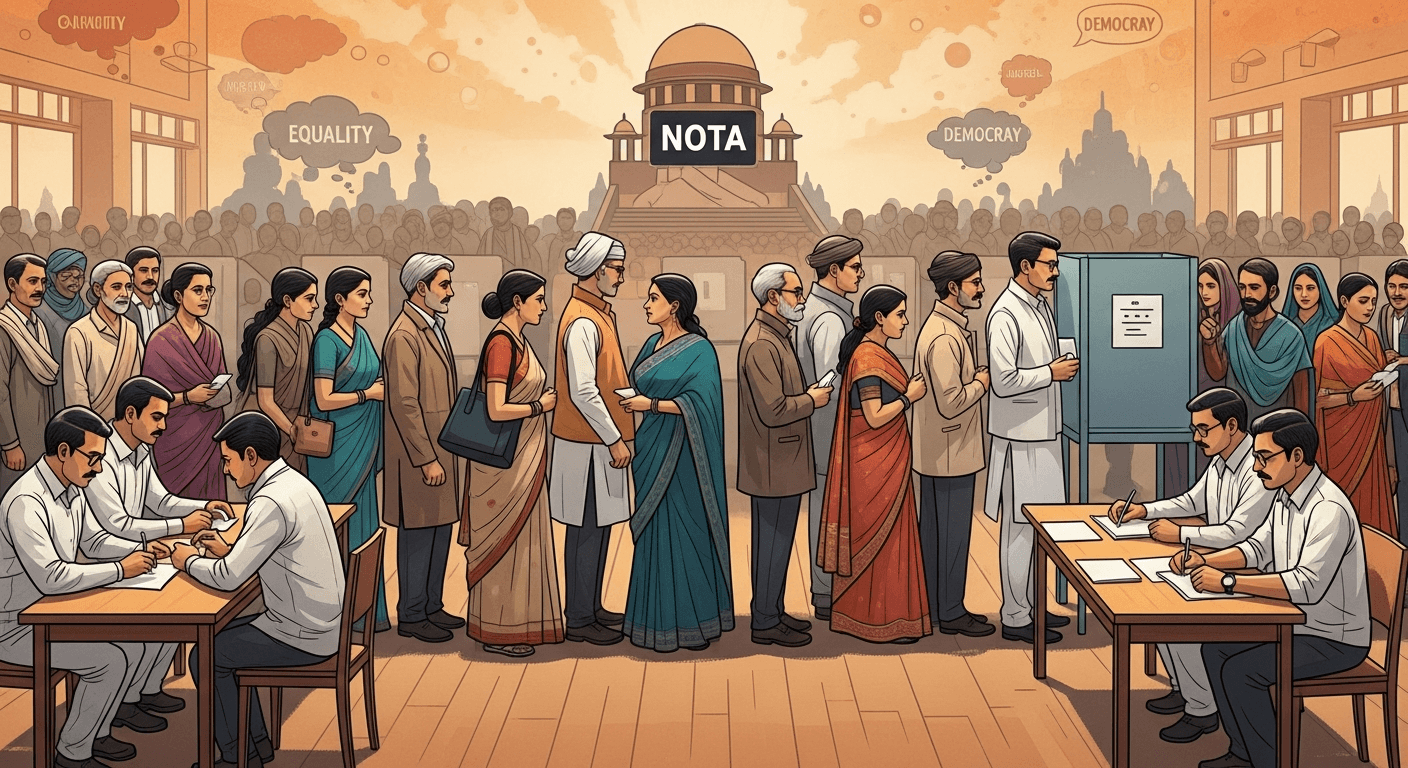
Why the Supreme Court's Remark Matters
I read the Times of India report prompting a simple — yet urgent — conversation: the Supreme Court has suggested that India needs a mechanism, not necessarily punitive, to ensure more people vote so that our democracy becomes stronger and the NOTA option loses its limited usefulness Need mechanism to make voting mandatory: Supreme Court | India News - The Times of India.
This was not a judicial diktat but a candid observation from a bench hearing petitions about whether elections should still be held where there is only one candidate (so voters can use NOTA meaningfully). The bench asked an important question: if voters don't turn up, can the democratic mandate be said to be healthy?
My read: three interlocking problems
- Voter apathy among certain segments. The court noted a paradox we often see: turnout can be higher in economically disadvantaged or rural pockets while some educated and well-off sections stay away. That gap matters for representation.
- NOTA's limited effect. NOTA was intended as a pressure valve to improve candidate quality, but low usage and no consequence has weakened that signal.
- Structural friction. Millions of citizens are literally unable to vote because of distance, work, illness, or registration issues. Compulsion without fixing these frictions is hollow.
Compulsory — but not cruel: what I think a humane mechanism looks like
If we are serious about improving participation, the mechanism must be realistic, minimally coercive, and fairness-preserving. A few practical ideas:
- Make voting easy first: same-day and online/any-booth voting, better absentee/postal options for migrants, workplace polling days, and mobile polling vans in remote areas.
- Incentives over punishments: modest tax rebates, a civic credit, or entry into a small, transparent lottery for those who vote. Positive nudges work better than threats.
- Administrative default nudges: automatic reminders, free time-off mandates for election day, and employer facilitation rather than penalties for non-voters.
- Make NOTA consequential in limited, well-defined ways — for example, where NOTA gets a clear plurality, trigger a re-run with fresh candidate nominations or a minimum threshold rule (but only after thorough parliamentary debate and constitutional checks).
These measures assume political will and administrative capacity. They also respect the core democratic value that voting is a right — but one tied to civic responsibility.
Practical pitfalls to guard against
- Punitive fines would likely be regressive and poorly enforced; they could criminalize poverty or the inconvenient.
- Any mechanism that looks like a surveillance tool (tracking who voted and why) will chill freedoms.
- Quick legal fixes by courts are neither desirable nor sustainable — electoral architecture needs legislation, public debate, and careful policy design.
Where I have been on this before
I have written about NOTA, compulsory voting and the practical limits of legal compulsion in the past. See my earlier pieces where I cautioned that a law alone is not the answer and stressed the need to remove practical barriers to voting:
- "Compulsory voting worth a try in India, says NITI Aayog CEO Amitabh Kant" (my commentary) — https://lnkd.in/fQMGfHg
- "N O T A (None Of The Above)" — https://myblogepage.blogspot.com/2013/10/n-o-t-none-of-above.html
These posts argued the same central point: if we want 100% participation, we must redesign systems to make voting truly feasible for everyone, not merely punish non-participation.
A compact road map I would back
- Launch an intensive pilot in a couple of states: combined measures — convenient voting, incentives, stronger civic education — monitored for turnout and equity effects.
- Make administrative reforms (any-booth voting, better registration, absentee processes) national priorities before debating compulsion.
- If compulsion remains under consideration, adopt positive compulsion: incentives and facilitation rather than fines; parliamentary debate to calibrate constitutional questions; sunset clauses and evaluations.
- Strengthen NOTA's role through democratic debate — any change to make NOTA consequential must be legislated with safeguards to prevent unintended consequences (e.g., repeated nullified elections, capture by vested interests).
Final reflection
Democracy is not merely a set of legal rules; it is a living contract between citizens and institutions. I welcome the Supreme Court's provocation because it forces a deeper question: are our institutions designed to make participation simple, meaningful and safe? If the answer is no, the remedy is design and will — not only compulsion.
We should aim for systems that make voting easy, worth the time, and consequential in improving candidate quality. If those fail despite sustained effort, we can revisit harder options — but only after we try the practical steps first.
Regards,
Hemen Parekh
Any questions / doubts / clarifications regarding this blog? Just ask (by typing or talking) my Virtual Avatar on the website embedded below. Then "Share" that to your friend on WhatsApp.
Get correct answer to any question asked by Shri Amitabh Bachchan on Kaun Banega Crorepati, faster than any contestant
Hello Candidates :
- For UPSC – IAS – IPS – IFS etc., exams, you must prepare to answer, essay type questions which test your General Knowledge / Sensitivity of current events
- If you have read this blog carefully , you should be able to answer the following question:
- Need help ? No problem . Following are two AI AGENTS where we have PRE-LOADED this question in their respective Question Boxes . All that you have to do is just click SUBMIT
- www.HemenParekh.ai { a SLM , powered by my own Digital Content of more than 50,000 + documents, written by me over past 60 years of my professional career }
- www.IndiaAGI.ai { a consortium of 3 LLMs which debate and deliver a CONSENSUS answer – and each gives its own answer as well ! }
- It is up to you to decide which answer is more comprehensive / nuanced ( For sheer amazement, click both SUBMIT buttons quickly, one after another ) Then share any answer with yourself / your friends ( using WhatsApp / Email ). Nothing stops you from submitting ( just copy / paste from your resource ), all those questions from last year’s UPSC exam paper as well !
- May be there are other online resources which too provide you answers to UPSC “ General Knowledge “ questions but only I provide you in 26 languages !


No comments:
Post a Comment