
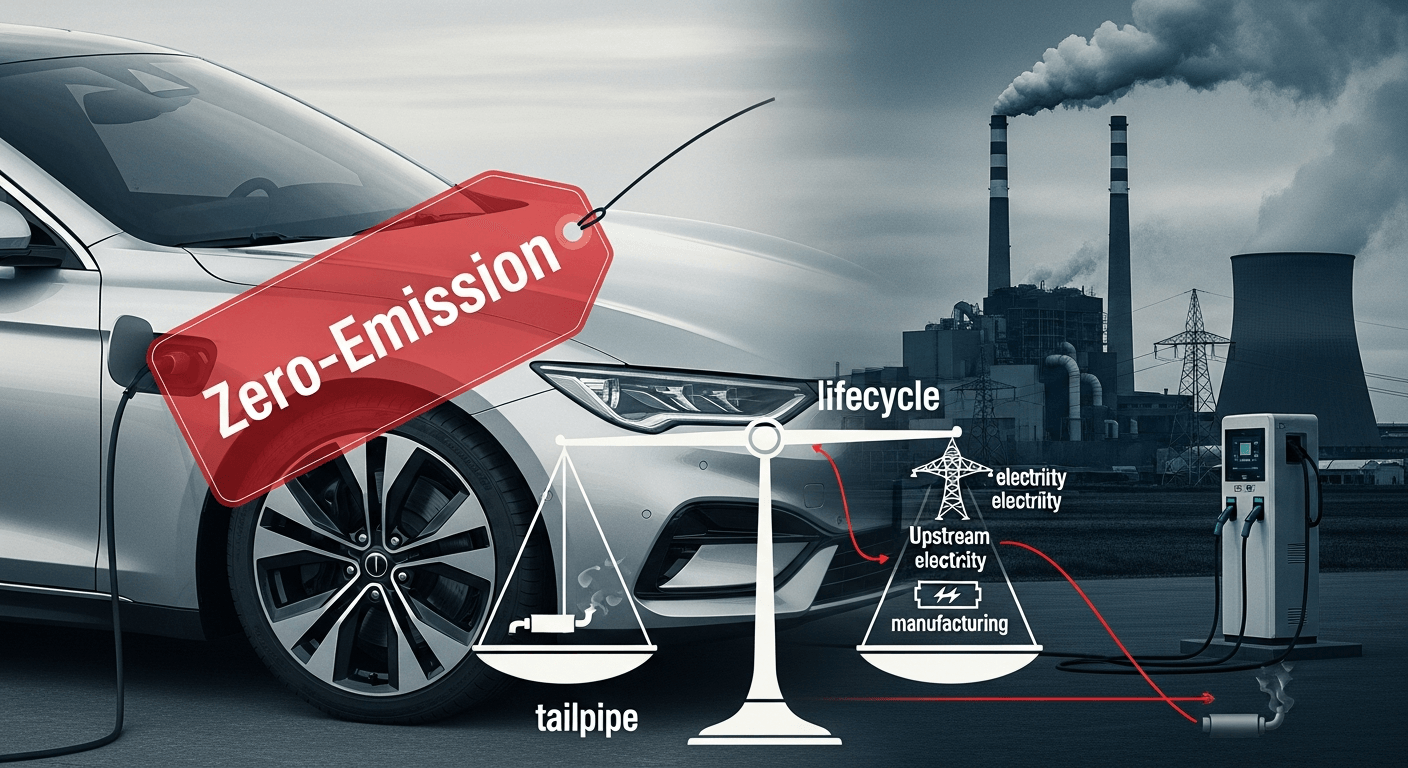
I write often about cars and energy because the two are now inseparable. Today I want to explain why a regulatory shift called “CAFE III” may strip battery electric vehicles (EVs) of their formal “zero-emission” label — what that means, who pushed for it, and what drivers should watch for.
What is the CAFE III proposal?
CAFE (Corporate Average Fuel Economy) is the U.S. program that sets fleetwide fuel-economy targets for automakers. The current debate centers on a major recalibration proposed in late 2025 — often described in coverage of the Safer Affordable Fuel-Efficient (SAFE) Vehicles Rule III (sometimes referred to in shorthand as CAFE III). The proposal would relax fleet fuel-economy requirements for model years spanning the 2020s and change assumptions the agency uses when setting baselines and targets DLA Piper, Dec 2025.
A critical technical shift in the proposal: the agencies are debating whether “zero-emission” should mean only tailpipe emissions (what comes out of the car’s tailpipe) or a broader lifecycle measure that includes upstream electricity generation, battery manufacturing and recycling, and other upstream (“well‑to‑wheel”) emissions.
How might the EPA redefine “zero‑emission”?
The Environmental Protection Agency (EPA) has signaled a willingness to reconsider earlier assumptions. Under one path, the agency would retain the current, technology‑based definition (battery and fuel‑cell vehicles = zero tailpipe emissions). Under another, it would explicitly incorporate:
- Lifecycle emissions: greenhouse gases and pollutants from mining, battery production, manufacturing, and end‑of‑life processing.
- Upstream power‑plant emissions: CO2 and local pollutants associated with the generation mix that charges EVs.
- Grid charging behavior: where and when EVs charge — charging on a coal‑heavy grid at peak times yields a different footprint than charging on a renewables‑rich grid overnight.
Those questions have been part of public debate since EPA’s 2024 tailpipe and Multi‑Pollutant rules and re‑surfaced during the 2025 reconsideration steps and industry comments EPA multi‑pollutant and NHTSA/EPA actions, 2023–2025; Alliance for Automotive Innovation comments, Sep 2025.
Why regulators are considering this change
- Grid emissions: In regions where electricity still depends heavily on coal, charging an EV can shift emissions upstream to power plants. Regulators worry labels that ignore that reality may mislead consumers.
- Equity and local air quality: Some policymakers argue emissions should reflect who bears pollution burdens (e.g., communities near power plants or battery factories).
- Industry lobbying: Automakers and suppliers have urged a technology‑neutral, lifecycle approach — partly to avoid rules that functionally require fleet electrification. Industry groups argued this in comments in 2025 after EPA’s earlier rules [industry filings, 2025].
- Technological neutrality: Some regulators frame lifecycle accounting as a way to compare EVs, advanced hybrids, synthetic fuels and fuel‑cell vehicles on the same basis.
What losing the “zero‑emission” label would mean
- Consumer perception: The simple shorthand — “an EV = zero emissions” — would become more complicated. Labels that once reassured buyers could create confusion and erode confidence.
- Incentives and tax credits: Federal and state purchase incentives often target “zero‑emission” vehicles. A new definition could change eligibility or push states to rewrite ZEV (Zero Emission Vehicle) mandates.
- State ZEV mandates: California’s program and states that follow it rely on the zero‑emission concept to drive automaker compliance. A federal redefinition could complicate that compliance pathway or invite legal challenges.
- Automaker strategy and investment: If lifecycle accounting downplays the advantage of EVs in some markets, automakers may slow EV investments or diversify into hybrids, e‑fuel research, and hydrogen.
- Charging infrastructure: Incentives to build fast chargers and green‑charging programs could be altered if regulators place more emphasis on where energy comes from.
Viewpoints from different stakeholders
- EPA (regulatory view): Seeks to ensure labels and standards reflect overall environmental outcomes and address local and upstream impacts.
- Automakers / industry groups: Many urge lifecycle and technology‑neutral rules to preserve flexibility and avoid de facto mandates; they argue feasibility concerns for meeting aggressive fleet targets without alternatives [industry comments, 2025].
- Environmental groups: Some worry that relaxing the zero‑emission stance undermines the rapid decarbonization imperative; others welcome lifecycle rigor if it pushes grids to decarbonize faster.
- EV advocates: Fear a semantic change could chill consumer demand and investment in charging networks at a critical growth phase.
- Utilities: See opportunity — lifecycle rules place more focus on grid decarbonization and managed charging programs.
What consumers should watch for
- Incentives and labeling: Watch federal and state guidance on which vehicles qualify for tax credits, rebates or carpool lane access.
- New window‑stickers: Agencies may update window labels to show lifecycle greenhouse‑gas intensity, charging‑source guidance, or a simple “score.”
- Total cost of ownership (TCO): Continue to compare TCO — fuel/energy, maintenance, incentives, resale value — not just sticker claims.
- Charging sources: If possible, use utilities’ green‑tariff programs or time‑of‑use plans and seek renewable charging to reduce your personal lifecycle footprint.
I’ve written about the EV‑grid intersection before; the framing today builds on earlier posts where I flagged the importance of charging sources and lifecycle thinking [“Battle of Electric Vehicles,” my past post].(http://mylinkedinposting.blogspot.com/2024/09/battle-of-electric-vehicles.html)
Conclusion — practical advice
Regulators are rightly wrestling with complexity. A shift in definition would reflect real environmental tradeoffs — but it also risks muddying a simple message that helped spur EV adoption. For now, consumers should:
- Track incentive changes in your state and at the federal level.
- Compare total cost of ownership (not just tailpipe claims).
- Prefer charging from cleaner grids or via renewable tariffs when available.
- Watch labels: expect more detailed lifecycle or grid‑source information on window stickers and dealer materials.
Regulation is changing; good consumer choices will rely on clearer information and a focus on real costs and real emissions.
Regards,
Hemen Parekh
Any questions / doubts / clarifications regarding this blog? Just ask (by typing or talking) my Virtual Avatar on the website embedded below. Then "Share" that to your friend on WhatsApp.
Get correct answer to any question asked by Shri Amitabh Bachchan on Kaun Banega Crorepati, faster than any contestant
Hello Candidates :
- For UPSC – IAS – IPS – IFS etc., exams, you must prepare to answer, essay type questions which test your General Knowledge / Sensitivity of current events
- If you have read this blog carefully , you should be able to answer the following question:
- Need help ? No problem . Following are two AI AGENTS where we have PRE-LOADED this question in their respective Question Boxes . All that you have to do is just click SUBMIT
- www.HemenParekh.ai { a SLM , powered by my own Digital Content of more than 50,000 + documents, written by me over past 60 years of my professional career }
- www.IndiaAGI.ai { a consortium of 3 LLMs which debate and deliver a CONSENSUS answer – and each gives its own answer as well ! }
- It is up to you to decide which answer is more comprehensive / nuanced ( For sheer amazement, click both SUBMIT buttons quickly, one after another ) Then share any answer with yourself / your friends ( using WhatsApp / Email ). Nothing stops you from submitting ( just copy / paste from your resource ), all those questions from last year’s UPSC exam paper as well !
- May be there are other online resources which too provide you answers to UPSC “ General Knowledge “ questions but only I provide you in 26 languages !




No comments:
Post a Comment