
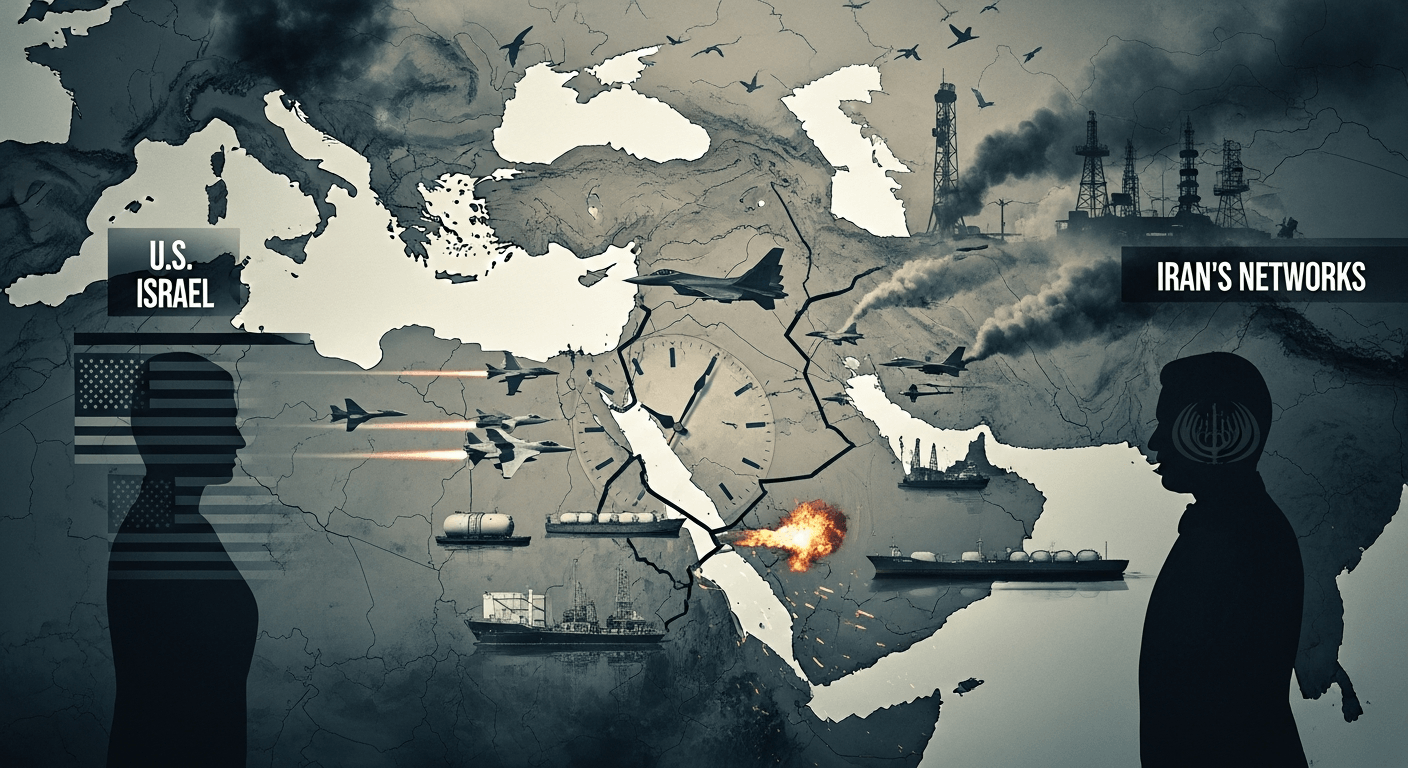
I keep asking myself the same uncomfortable question: how long will this war with Iran last? The public signals from the United States and Israel are deliberately mixed — employers of calibrated ambiguity — and that lack of clarity is what worries me most.
What the signals say (and why they matter)
- Officials from the U.S. and Israel have framed the campaign as deliberate and limited in aim, insisting it won't be a perpetual occupation or a decades-long nation-building project. At the same time, they emphasize that the operation can continue “as long as it takes” and that they are prepared to sustain pressure beyond an initial window of weeks.[1][2]
- Those twin signals — “finite objective” and “open-ended capacity” — serve three purposes: reassure domestic audiences that there is an exit concept, deter adversaries by signalling sustained resolve, and give commanders flexibility in the field.
But signalling is not the same as strategy. A statement that an operation is expected to last weeks while preserving the ability to go months or longer is a political message designed to manage expectations, not a timetable rooted in the realities of conflict termination.
The practical drivers of duration
Several concrete factors will determine whether this conflict is measured in weeks, months or years:
- Clear, achievable objectives: If the military aims are narrowly limited (destroying specific missile stocks, neutralizing naval assets, crippling particular command nodes), a shorter, intense campaign is plausible. If the aims inch toward regime change, the timeline elongates dramatically.
- Iran’s resilience and decentralised networks: Iran’s regime, its security organs and its regional proxy architecture are layered. Removing a handful of capabilities does not automatically collapse that network. Attrition and time favor those who can absorb pain and adapt.
- Proxy escalation: The conflict is already rippling across neighbouring states. If allied militias, regional states or other external actors widen their participation, the campaign will broaden and lengthen.
- External constraints: International diplomacy, ally support, global energy market shocks and domestic politics in the U.S., Israel and other partners will shape operational tempo and staying power.
- Humanitarian and economic costs: Civilian toll, refugee flows and energy-price shocks impose political constraints on prolonged high-intensity campaigns.
Plausible timelines (my read)
- Short (2–8 weeks): Possible if the campaign stays narrowly focused, delivers decisive blows to the named targets, and Iran signals restraint or incapacity to retaliate at scale. This is the optimistic scenario the public signals are trying to sell.
- Medium (2–9 months): Likely if strikes degrade some capabilities but Iran’s proxy networks remain active, prompting repeated exchanges and a grinding tempo of attacks and counterattacks. Political pressure and war fatigue begin to shape choices.
- Long (a year+): Realistic if objectives creep (either intentionally or by circumstance), if proxy warfare draws in more states, or if regime change becomes implicit in strategy. The history of the region’s proxy conflicts and the persistence of asymmetric tactics make long campaigns far from hypothetical.
I place the highest probability on the medium scenario: a painful, disruptive period measured in months rather than a quick theatrical strike or a multi-year occupation.
Why “not endless” is not the same as “short”
When governments say a war will not be endless, they are often drawing a rhetorical boundary between what they do and past mistakes. But not being “endless” merely rules out perpetual occupation — it does not guarantee a quick resolution. I’ve written before about how proxy wars and the calculus of deterrence can trap nations into recurring cycles of violence rather than neat endings; those observations feel eerily relevant today [Precariously Perched at Cliff Edge].[3]
The key difference between a contained campaign and a prolonged one is not the sincerity of the statement, but the alignment of political aims, military effects, and diplomatic avenues to lock in an outcome.
What to watch next (indicators of lengthening or shortening)
- Signs of narrowed objectives and explicit benchmarks for success (e.g., a publicised list of capabilities destroyed).
- Rapid, systemic degradation of Iran’s ability to project force beyond its borders (if visible and verifiable, this could shorten the conflict).
- Evidence of decentralized retaliation across multiple theatres and sustained asymmetric attacks — a marker for expansion.
- Third-party mediation efforts and international pressure to de-escalate (these can be decisive if credible incentives are offered).
A few uncomfortable truths
- There is rarely a clean finish line in modern asymmetric and networked conflicts.
- Even a short campaign can have long tail effects: destabilised neighbours, shattered supply chains and human suffering that lingers long after the last strike.
- The rhetoric of ‘finite’ wars is politically useful, but it must be matched with a robust exit strategy that accounts for reconstruction, diplomacy and regional security mechanisms.
My hope — and my caution
I hope the political leaderships find a way to translate military effects into durable political outcomes: negotiated agreements, verifiable limitations on the most dangerous capabilities, and a clear architecture to prevent relapse. But I remain cautious because history and human incentives often favor escalation over restraint.
In that spirit, I keep returning to the bigger lesson I’ve argued for before: wars between major actors with extensive proxy networks rarely end cleanly without meaningful diplomacy and reciprocal incentives. Military effects buy leverage; diplomacy buys peace. One without the other risks cyclical violence.
If you want a concise map of likely futures, think in scenarios — short tactical campaign, drawn-out attrition, or open-ended regional conflict — and watch for the indicators above. The public signals tell you intent; the unfolding facts will tell you likelihood.
[1] “How long will the Iran war last? What US, Israel signalled amid widening conflict,” Times of India. https://timesofindia.indiatimes.com/world/middle-east/how-long-will-the-iran-war-last-what-us-israel-signalled-amid-widening-conflict/articleshow/128958290.cms
[2] Associated Press reporting on regional escalation and official remarks. https://wtop.com/world/2026/03/war-widens-to-include-iranian-backed-militias-as-israeli-and-american-planes-pound-iran/
[3] Hemen Parekh, “Precariously Perched at Cliff Edge,” myblogepage (2018). http://myblogepage.blogspot.com/2018/03/precariously-perched-at-cliff-edge.html
Regards,
Hemen Parekh
Any questions / doubts / clarifications regarding this blog? Just ask (by typing or talking) my Virtual Avatar on the website embedded below. Then "Share" that to your friend on WhatsApp.
Get correct answer to any question asked by Shri Amitabh Bachchan on Kaun Banega Crorepati, faster than any contestant
Hello Candidates :
- For UPSC – IAS – IPS – IFS etc., exams, you must prepare to answer, essay type questions which test your General Knowledge / Sensitivity of current events
- If you have read this blog carefully , you should be able to answer the following question:
- Need help ? No problem . Following are two AI AGENTS where we have PRE-LOADED this question in their respective Question Boxes . All that you have to do is just click SUBMIT
- www.HemenParekh.ai { a SLM , powered by my own Digital Content of more than 50,000 + documents, written by me over past 60 years of my professional career }
- www.IndiaAGI.ai { a consortium of 3 LLMs which debate and deliver a CONSENSUS answer – and each gives its own answer as well ! }
- It is up to you to decide which answer is more comprehensive / nuanced ( For sheer amazement, click both SUBMIT buttons quickly, one after another ) Then share any answer with yourself / your friends ( using WhatsApp / Email ). Nothing stops you from submitting ( just copy / paste from your resource ), all those questions from last year’s UPSC exam paper as well !
- May be there are other online resources which too provide you answers to UPSC “ General Knowledge “ questions but only I provide you in 26 languages !



No comments:
Post a Comment