
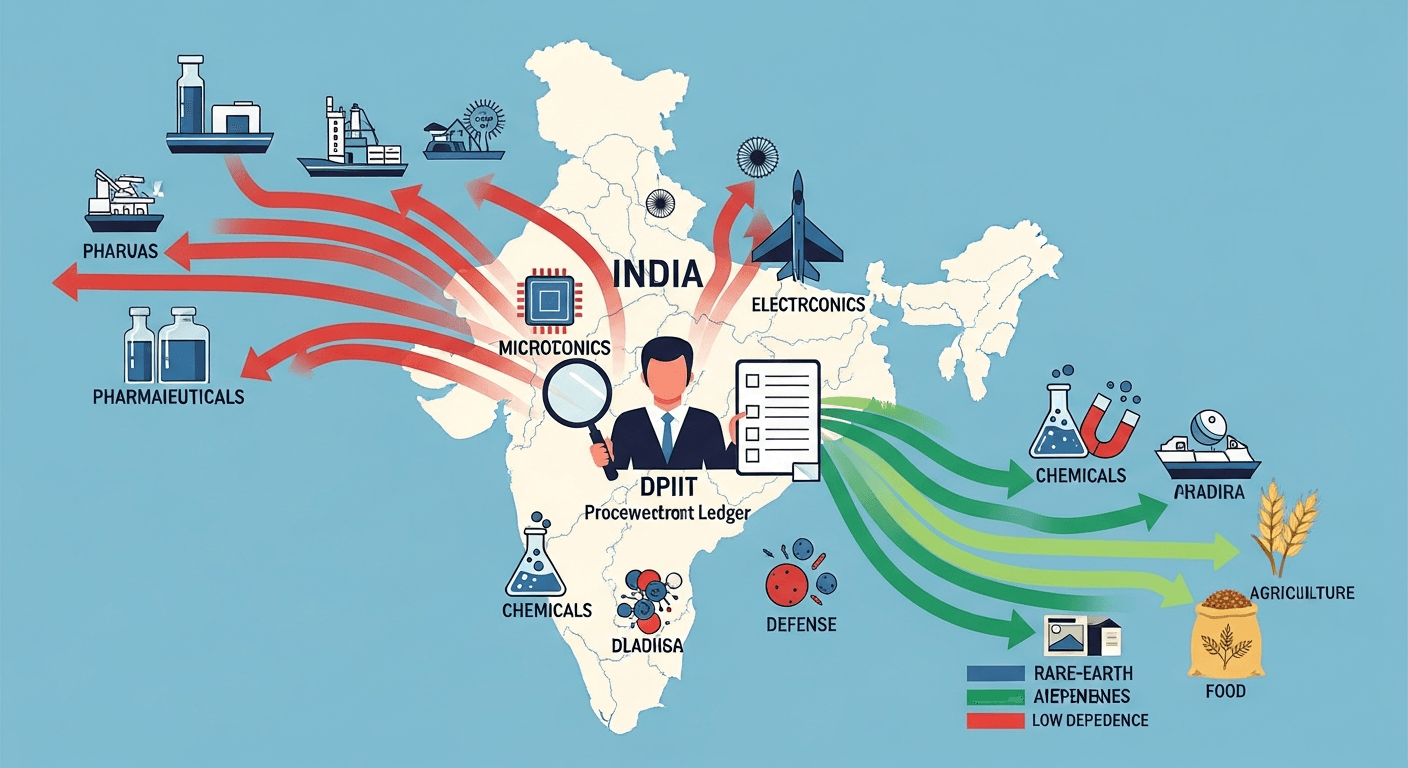
Mapping India's Import Reliance
I write this as someone who has watched India’s supply chains and procurement systems evolve for decades: the government's recent decision to run a structured exercise to map import reliance is practical, overdue and potentially transformative. This mapping—being coordinated by the Department for Promotion of Industry and Internal Trade (DPIIT) and connected to procurement platforms such as the Government e-Marketplace (GeM)—aims to identify where India depends on foreign suppliers and where domestic industry can fill gaps India is conducting exercise for mapping import reliance.
Connect with me: Hemen Parekh — hcp@recruitguru.com
Why this exercise matters
At its core, the mapping is a diagnostic: it will collect item-level procurement data across ministries, map those items to import codes (HS/HSN), and estimate the scale and frequency of imports. The output will let policymakers distinguish:
- Items where India already has latent or emerging domestic capacity
- Items that are strategic or single-sourced internationally
- Items that are intermediate inputs crucial to multiple sectors (and therefore systemically important)
This matters because high import concentration — even for non-strategic goods — can create cascading vulnerabilities across industry, defence and public services. The DPIIT-led effort dovetails with broader objectives under Make in India, Atmanirbhar Bharat and recent supply-chain discussions under multilateral frameworks DPIIT Launches Nationwide Import Reliance Mapping Drive.
Methodology: how the mapping can and should work
From what government briefings describe and from best practice elsewhere, the mapping should combine:
- Procurement-data aggregation
- Consolidate five years of central procurement (GeM + departmental records) mapped to tariff/HSN codes.
- Sectoral consultations
- Ministries, public sector undertakings and industry bodies validate item lists and domestic capacities.
- Import concentration analysis
- For each HS/HSN item compute supplier concentration, country share, and single-source risk metrics.
- Supply-chain criticality scoring
- Rate items by substitutability, lead time, and systemic impact (e.g., defence vs. stationery).
- Roadmaps and procurement nudges
- For items deemed substitutable, create five-year procurement roadmaps, local-content thresholds, and demand-aggregation windows (GeM can support category-wise consolidation).
This mix of quantitative import statistics and qualitative sector inputs is the sensible path; it avoids knee-jerk protectionism while flagging realistic opportunities for import substitution.
Sectors being mapped (and why they matter)
The government has prioritised sectors where import dependence is visible and where risks are either economic or strategic: pharma, electronics, chemicals, defence, rare earths/critical minerals and food systems.
- Pharmaceuticals: India is a global generic-drug manufacturing hub, but remains import-dependent for many APIs and specialised intermediates. Addressing this requires targeted incentives, bulk-drug parks and predictable public procurement [see related policy debates].
- Electronics: High import intensity for components (PCBs, semiconductor-dependent modules) undercuts domestic value capture; demand aggregation and PLI-style incentives are relevant.
- Chemicals: Intermediates and speciality chemicals feed many industries; mapping can reveal where feedstock security or processing capacity is the choke point.
- Defence: Dual imperative of security and indigenisation — mapping should feed into procurement offsets and strategic stockpiles.
- Rare earths & critical minerals: These are input constraints for EVs, renewables and defence; the mapping must extend to processing and refining capability, not just mining.
- Food & agro-inputs: Some food items and key agri-intermediates (e.g., certain edible oils, fertilizers) remain import-sensitive and have macro implications.
Implications for policy and industry
Positive policy levers enabled by a rigorous map:
- Targeted production-linked incentives (PLI) for items where scale can be commercially achieved.
- Procurement-driven demand visibility: five-year consolidated procurement commitments can de-risk investments for manufacturers.
- Smarter trade policy: calibrated tariffs, anti-dumping measures, or negotiated diversification depending on whether the issue is price competition or supply concentration.
- Strategic stockpiles and contingency sourcing for single-sourced critical items.
For industry, a clear map is a market signal: it tells investors where predictable demand, procurement thresholds and potential incentives will flow.
Potential benefits and risks
Benefits:
- Resilience: fewer disruptions from single-country or single-supplier failures.
- Job creation: domesticisation of intermediate inputs can create higher-value manufacturing jobs.
- Strategic autonomy: reduced strategic exposure in defence, energy, and critical tech.
Risks and caveats:
- Cost and competitiveness: premature or blanket import substitution can raise costs for consumers and downstream producers.
- Retaliation: poorly calibrated trade measures could invite trade friction with key partners.
- Misallocation: political pressure could push subsidised capacity into products India cannot efficiently produce at scale.
The right balance is a selective, data-driven approach: use mapping to identify feasible substitution opportunities and protect truly strategic items — not to erect broad protectionist walls.
International context
The mapping exercise occurs in a global environment where countries are rethinking supply chains after pandemic shocks and geopolitical tensions. Multilateral initiatives (and regional pacts) increasingly focus on supply-chain resilience; India’s exercise needs to align with these while safeguarding domestic industrial policy. Opening government procurement in some FTAs increases the need to be precise: if India invites foreign bidders under certain deals, it must know where domestic industry can realistically compete and where it cannot [Economictimes coverage].
Suggested next steps for policymakers
- Publish a methodology and timeline to build confidence and invite industry participation.
- Start with a pilot list of 100–200 high-risk items across the named sectors (pharma APIs, select electronics components, rare-earth inputs, defence subsystems, critical chemicals and a shortlist of food intermediates).
- Use GeM for demand aggregation and to publish forward procurement commitments tied to local-content milestones.
- Pair mapping outputs with finance (credit lines, de-risking instruments) and capability-building (SKUs for clusters, quality certification programs).
- Institute a periodic review: supply chains evolve; mapping should be refreshed annually and linked to strategic stockpile and diversification plans.
My previous reflections
I have written previously about the power of demand visibility, procurement platforms and structured supply-chain thinking in enabling domestic industry to scale. Those earlier posts explored how procurement design and technology can reshape supplier markets — the present mapping exercise is precisely the kind of policy infrastructure I long argued India needs; it is heartening to see it take shape in an explicit, cross-ministry way (see one of my earlier posts for context: "Who needs Fulfillment Centres? Not Reliance Retail").
Conclusion
A disciplined import-reliance map is a tool, not a verdict. Done well, it becomes the backbone of pragmatic industrial policy: a way to prioritise incentives, target procurement to grow domestic capability, and shore up strategic supply lines without succumbing to blanket protectionism. Done poorly, it risks creating false hopes and expensive, inefficient capacity. The choice is simple: let data guide the strategy, and use procurement — transparently and predictably — to turn potential into production.
Regards,
Hemen Parekh — hcp@recruitguru.com
Any questions / doubts / clarifications regarding this blog? Just ask (by typing or talking) my Virtual Avatar on the website embedded below. Then "Share" that to your friend on WhatsApp.
Get correct answer to any question asked by Shri Amitabh Bachchan on Kaun Banega Crorepati, faster than any contestant
Hello Candidates :
- For UPSC – IAS – IPS – IFS etc., exams, you must prepare to answer, essay type questions which test your General Knowledge / Sensitivity of current events
- If you have read this blog carefully , you should be able to answer the following question:
- Need help ? No problem . Following are two AI AGENTS where we have PRE-LOADED this question in their respective Question Boxes . All that you have to do is just click SUBMIT
- www.HemenParekh.ai { a SLM , powered by my own Digital Content of more than 50,000 + documents, written by me over past 60 years of my professional career }
- www.IndiaAGI.ai { a consortium of 3 LLMs which debate and deliver a CONSENSUS answer – and each gives its own answer as well ! }
- It is up to you to decide which answer is more comprehensive / nuanced ( For sheer amazement, click both SUBMIT buttons quickly, one after another ) Then share any answer with yourself / your friends ( using WhatsApp / Email ). Nothing stops you from submitting ( just copy / paste from your resource ), all those questions from last year’s UPSC exam paper as well !
- May be there are other online resources which too provide you answers to UPSC “ General Knowledge “ questions but only I provide you in 26 languages !



No comments:
Post a Comment